Learning how to write a freelance proposal correctly has become the single most important skill in 2026. Talent alone no longer guarantees projects… Clients now receive hundreds of bids within hours. As a result, your proposal decides whether you earn or stay invisible.
In my experience consulting with over 5,000 freelancers and agencies globally, I’ve seen skilled professionals lose projects to beginners. The difference was never experienced.
The difference was in positioning.
A strong freelance proposal communicates clarity, confidence, and commercial thinking instantly.
Most freelancers still rely on outdated templates. Meanwhile, platforms use AI ranking systems, and clients scan proposals in under 20 seconds. This guide closes that gap.
You will learn how to write a proposal for freelance work that aligns with modern buyer psychology, platform algorithms, and real client expectations.
If your goal is consistent income, predictable clients, and long-term growth, mastering freelance proposals is no longer optional. It is your primary leverage point.

What a Freelance Proposal Really Is in 2026 (Not What Blogs Tell You)
A freelance proposal in 2026 is a conversion document, not an introduction… In reality, a freelance proposal is a decision-making tool for clients. It helps them quickly assess risk, clarity, and certainty of outcome.
A freelance proposal is not a cover letter. Most blogs still define it incorrectly. In reality, a freelance proposal is a decision-making tool for clients. It helps them quickly assess risk, clarity, and certainty of outcome.
Most beginners get this wrong by focusing on themselves. They list skills, tools, and years of experience. Clients do not care initially. Clients care about whether you understand their problem better than others bidding.
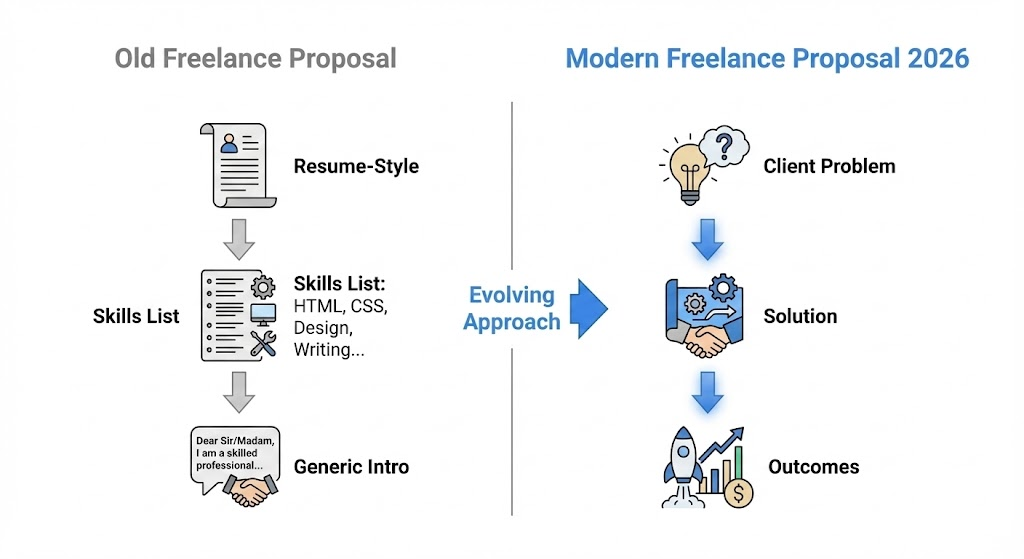
In 2026, proposals are scanned, not read. Marketplaces like Upwork and Freelancer rank proposals based on relevance signals, response speed, and clarity. A proposal that lacks structure gets buried, even if the skills match.
From a business perspective, your freelance proposal is a mini sales funnel. It attracts attention, builds trust, and moves the client toward a reply.
If it fails at any stage, the price becomes irrelevant.
This is why high-earning freelancers treat proposals as revenue assets. They refine them constantly, just like landing pages. This mindset shift alone increases reply rates dramatically.
Why Most Freelance Proposals Fail (Hard Truths From the Field)
Most freelance proposals fail because they are generic, self-centered, and price-driven. Clients reject proposals that lack personalization, clear outcomes, and risk reduction. The fastest way to lose projects is sounding like everyone else.
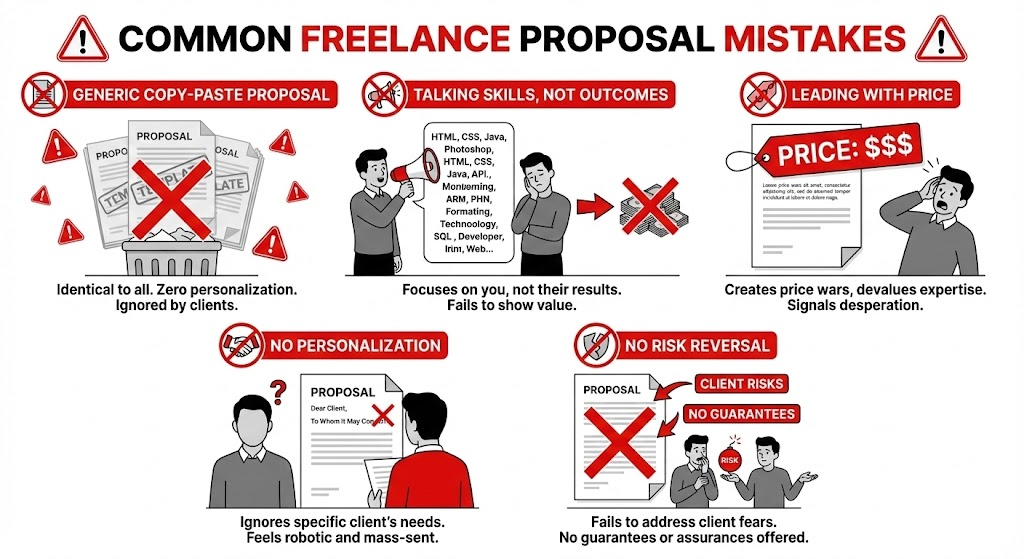
After reviewing thousands of proposals, the patterns are painfully clear. Freelancers lose projects before pricing even matters. The real issue lies in sameness. Clients receive identical introductions repeatedly.
One major mistake is copy-paste bidding. Freelancers reuse a single freelance proposal template across all clients. Platforms detect this behavior, and clients feel it instantly. Personalization is no longer optional.
Another common failure is feature dumping. Freelancers list services instead of outcomes. Clients don’t want “SEO services.” They want traffic growth, leads, or revenue.
Outcome clarity wins attention.
Many proposals also fail by leading with price. This signals desperation, not value. In premium freelancing, price comes after trust. Always.
Finally, beginners underestimate risk reversal. Clients fear delays, miscommunication, and wasted money. If your proposal does not address these fears, silence is guaranteed.
For deeper freelancing fundamentals, you can also explore What is Freelance Digital Marketing? A Beginner’s Guide.
The P.A.C.E. Proposal Framework™ (Proprietary Method #1)
The P.A.C.E. Proposal Framework™ structures freelance proposals into four conversion stages: Problem, Authority, Custom Execution, and Expected Outcome. This framework increases replies by aligning proposals with client decision psychology.
Over the years, I developed the P.A.C.E. Proposal Framework™ after testing hundreds of proposal variations. This framework consistently outperforms traditional formats across platforms and industries.
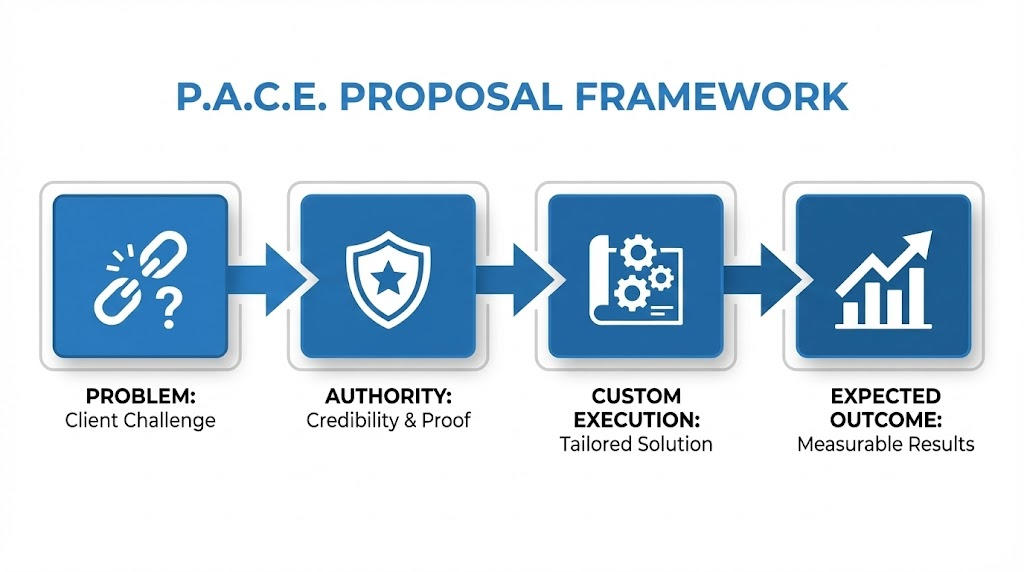
P.A.C.E. stands for:
- Problem: Show deep understanding of the client’s challenge
- Authority: Prove credibility without bragging
- Custom Execution: Present a tailored solution
- Expected Outcome: Define measurable results
The first section demonstrates empathy. When clients feel understood, they keep reading. This alone separates top freelancers from the crowd.
Authority comes next, but subtly. Instead of listing achievements, reference relevant experience. In my experience consulting with agencies, contextual proof converts better than credentials.
Execution outlines how you will solve the problem. Avoid overwhelming details. Clarity beats complexity.
Finally, expected outcomes remove uncertainty. Clients want to visualize success. When they can see results clearly, replies follow naturally.
If you’re planning to scale freelancing into a long-term career, understanding structured growth paths also helps. Read How to Start a Freelance Business in India? for a deeper context on building a sustainable career.
Step-by-Step: How to Write a Freelance Proposal That Gets Replies
To understand how to write a freelance proposal that gets replies, focus on personalization, problem clarity, solution relevance, and a low-friction call to action. High-converting proposals follow a logical flow that matches client scanning behavior.
If you are serious about learning how to write a freelance proposal correctly, you must stop improvising. Winning proposals follow a repeatable structure.
In 2026, clients skim proposals on mobile screens, often between meetings. This makes clarity and sequencing critical.
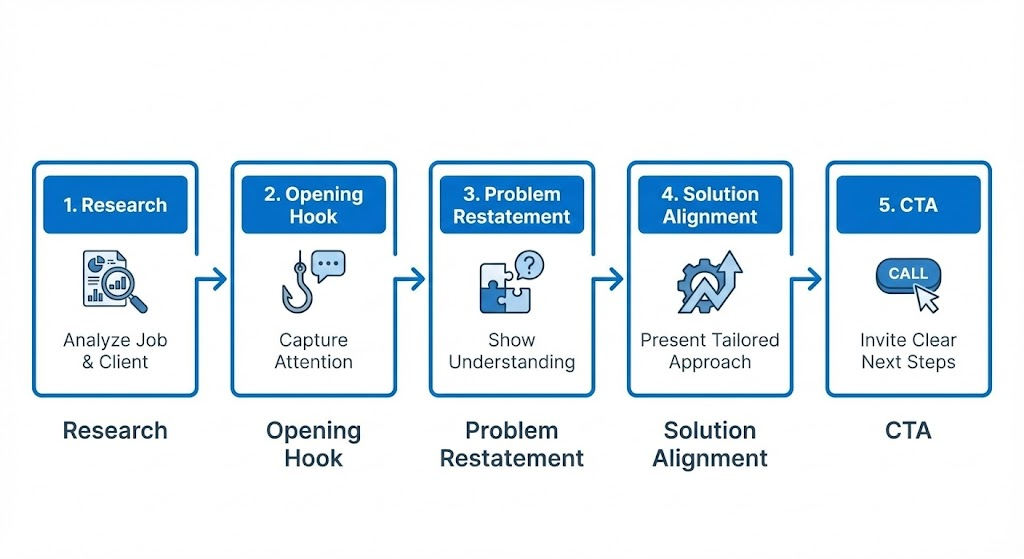
The first step is research. Before writing anything, analyze the job description deeply. Identify hidden intent signals such as urgency, budget sensitivity, or scalability needs.
Most freelancers skip this step, which is why their proposals sound generic.
Next comes the opening hook. Your first two lines decide everything. Avoid greetings like “Hope you are doing well.” Instead, reference the client’s exact problem.
This instantly signals relevance and increases read time.
Then, align your solution with the client’s language. Mirror keywords they used, but naturally. This improves both human trust and platform relevance scoring. It also shows that you understand their business context.
Finally, end with a micro-commitment CTA. Do not push for a call aggressively. Ask a low-risk question that invites a response. Replies happen when the client feels safe engaging.
For improving response psychology and communication skills, this guide on the Benefits of LinkedIn for Freelancers offers complementary insights.
Freelance Proposal Writing Process (Step-by-Step Flow)
The freelance proposal writing process includes five steps: job analysis, customized opening, solution framing, trust building, and clear CTA. Skipping any step reduces reply probability significantly.
A strong freelance proposal is not written in one pass. It follows a deliberate workflow. This workflow ensures every proposal feels custom without wasting time.
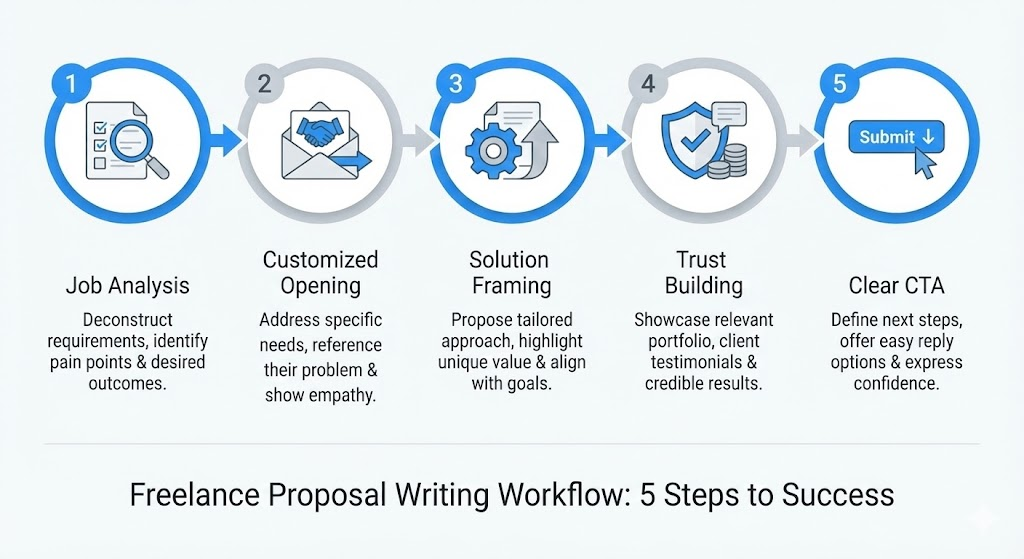
Start with a job breakdown.
Highlight pain points, desired outcomes, and constraints. This forms the backbone of your proposal. Freelancers who rush this step usually miss client expectations.
Next, write the opening and problem restatement. Keep it concise. Show empathy, not sympathy. Clients want professionals, not emotional validation.
Then outline your execution plan. Focus on how the client benefits, not what tools you use. Tools are interchangeable. Thinking is not.
Lastly, close with clarity. Mention timelines, communication style, and next steps. Predictability reduces client anxiety, which increases replies.
For freelancers transitioning into structured digital careers, How to Start a Career in Digital Marketing in 2026 provides a helpful perspective.
Freelance Proposal Structure Breakdown (Line-by-Line Explanation)
A high-converting freelance proposal structure includes a hook, problem summary, solution preview, execution details, outcomes, and CTA. Each section serves a specific psychological purpose.
Understanding structure is critical if you want to know how to write a good freelance proposal consistently. Structure removes guesswork. It also ensures your proposal is skimmable.
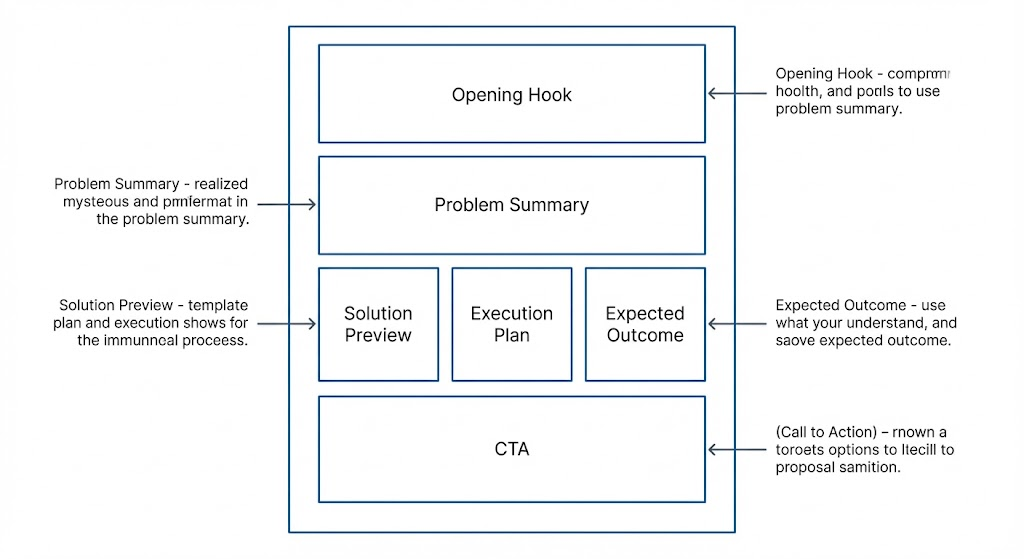
The opening headline should reference the client’s goal or challenge.
This anchors attention. Avoid generic titles. Precision builds credibility instantly.
The problem summary follows next. Restate the issue in your own words. When clients feel understood, they assume competence. This is a psychological shortcut.
After that, preview your solution. Keep it high-level. Avoid over-explaining. Detailed execution comes later during discussions.
End with a CTA that feels natural.
Invite conversation, not commitment. Clients prefer dialogue before decisions.
Ideal Freelance Proposal Structure Table
| Proposal Section | Purpose | Common Mistake |
| Opening Hook | Grab relevance | Generic greetings |
| Problem Summary | Show understanding | Repeating job post |
| Solution Preview | Position expertise | Over-detailing |
| Execution Plan | Build confidence | Tool obsession |
| Expected Outcome | Visualize success | Vague promises |
| CTA | Encourage reply | Pushy sales tone |
This structure works across industries, including content writing, graphic design, IT services, and digital marketing. It also adapts well to platform-based bidding systems.
Why Structure Beats Templates in 2026?
In 2026, structure matters more than templates. Templates save time, but structure drives conversions. Successful freelancers customize structure, not just words.
Many freelancers search endlessly for a freelance proposal template. This mindset is flawed. Templates provide speed, not results. Structure provides consistency and scalability.
Templates often encourage lazy personalization. Clients detect this immediately. In contrast, a strong structure allows flexible customization without sounding repetitive.
In my experience consulting with growing freelancers, those who focus on structure increase reply rates within weeks. They stop rewriting from scratch and start refining strategically.
Structure also helps when scaling. If you plan to grow into an agency or premium freelancing, structured proposals are non-negotiable.
To understand how freelancers scale into agencies, read How to Start a Digital Marketing Agency in 2026.
Best Freelance Proposal Templates (What to Use, What to Avoid)
When learning how to write a freelance proposal effectively, templates should act as flexible frameworks, not rigid scripts. The best freelance proposal templates support customization, clarity, and platform relevance without sounding automated.
If you are mastering how to write a freelance proposal, templates can help—but only when used correctly. Most freelancers misuse templates by copying them word-for-word. This destroys authenticity and lowers response rates instantly.
A good freelance proposal template gives you a structural base. It defines sections like opening, problem summary, solution, and CTA. However, the wording must always change based on the client.
There are different templates for different use cases. A freelance project proposal template works well for fixed-scope jobs. A freelance business proposal template fits long-term retainers or enterprise clients. Context matters.
Avoid templates filled with fluff. Phrases like “I am passionate” or “I assure quality work” add zero value. Clients ignore them subconsciously. Replace fluff with specifics.
In my experience, the highest-performing templates are minimal. They leave room for personalization while maintaining logical flow. Think structure, not scripting.
For freelancers in digital fields, pairing proposals with strong positioning helps. Read How to Create a Digital Marketing Portfolio to strengthen credibility alongside proposals.
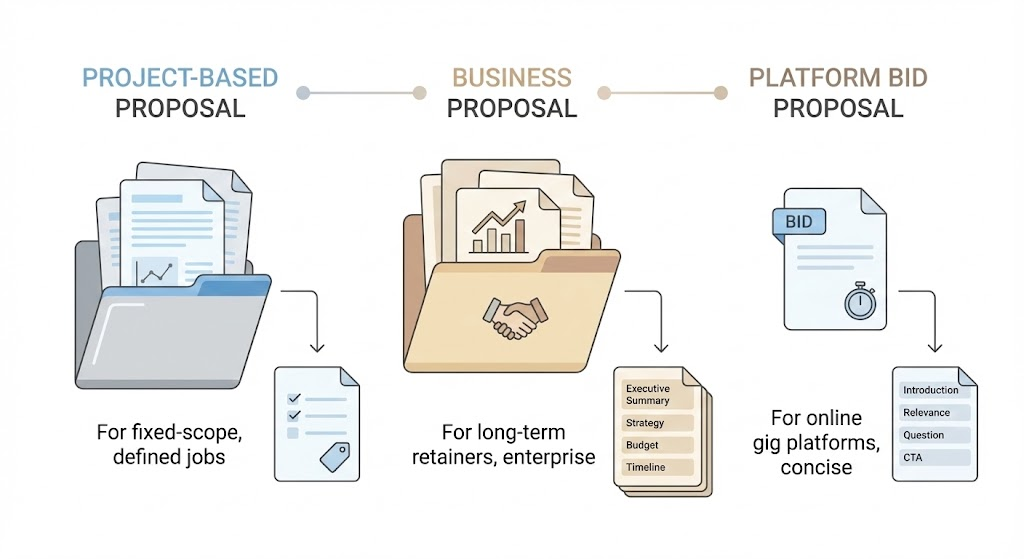
Recommended Freelance Proposal Template Structure
- Personalized opening line
- Client problem summary
- Proposed solution overview
- Execution approach
- Expected results
- Simple CTA
This structure adapts easily across platforms like Freelancer, Upwork, and direct email pitching.
How to Price Services Inside a Freelance Proposal (India + Global Clients)
Pricing inside a freelance proposal should reflect value, not effort. Effective pricing uses anchoring, scope clarity, and outcome-based positioning to justify rates across Indian and global markets.
Pricing is where most freelancers lose confidence. They either undercharge out of fear or over-explain to justify rates. Neither works. Pricing must feel logical, not defensive.
Start by framing value before numbers. Explain what the client gains, not what you do. When outcomes are clear, price resistance drops naturally.
For Indian clients, transparency matters. Break down deliverables and timelines. For global clients, focus on ROI and benchmarks. Cultural expectations influence perception.
Avoid hourly rates unless required. Project-based pricing signals professionalism. It also protects you from scope creep. Always define what is included clearly.
In proposals, use anchoring. Present a primary package and an optional upgrade. This gives clients a choice without negotiation chaos.
If you want deeper clarity on earning potential, read Digital Marketing Salary in India 2026 to align pricing with market realities.
Simple Pricing Presentation Table
| Pricing Style | Best For | Risk Level |
| Hourly | Short tasks | High |
| Project-Based | Defined scope | Medium |
| Retainer | Long-term work | Low |
How to Write a Bid Proposal for Freelance Platforms That Rank Higher?
To write a bid proposal for freelance work that ranks higher, align the proposal structure with platform algorithms, relevance signals, and early engagement factors without keyword stuffing.
Platforms like Upwork and Freelancer use AI-driven ranking systems. Your proposal is evaluated before a human reads it. Understanding this changes everything.
First, relevance matters. Mirror job post language naturally. This increases algorithmic matching without forced keyword usage. Avoid stuffing. Platforms penalize it.
Second, response speed matters. Early bids often get higher visibility. Prepare modular proposal components to respond quickly without sounding generic.
Third, engagement signals matter. Proposals that trigger replies, questions, or follow-ups get boosted. This is why CTAs should invite conversation, not close sales.
Most beginners ignore platform behavior. Top freelancers study it. That’s the difference between buried bids and consistent visibility.
If you want to leverage AI tools ethically for proposals, explore Secret ChatGPT Prompts for Freelancers to improve efficiency without losing authenticity.
Platform Optimization Checklist
- Respond within the first few hours
- Reference exact client requirements
- Keep proposals concise
- Ask one smart question
- Avoid external links unless asked
Freelance Proposal Examples (Winning vs Losing Comparisons)
The fastest way to master how to write a freelance proposal is by analyzing real examples. Winning proposals focus on client outcomes and clarity, while losing proposals focus on self-promotion and generic statements.
To truly understand how to write a freelance proposal that converts, examples matter more than theory. Over the years, I’ve audited thousands of proposals. The gap between winning and losing proposals is always obvious within the first three lines.
A losing proposal usually starts with the freelancer. It talks about skills, passion, and experience without context. Clients disengage immediately because their problem is not addressed.
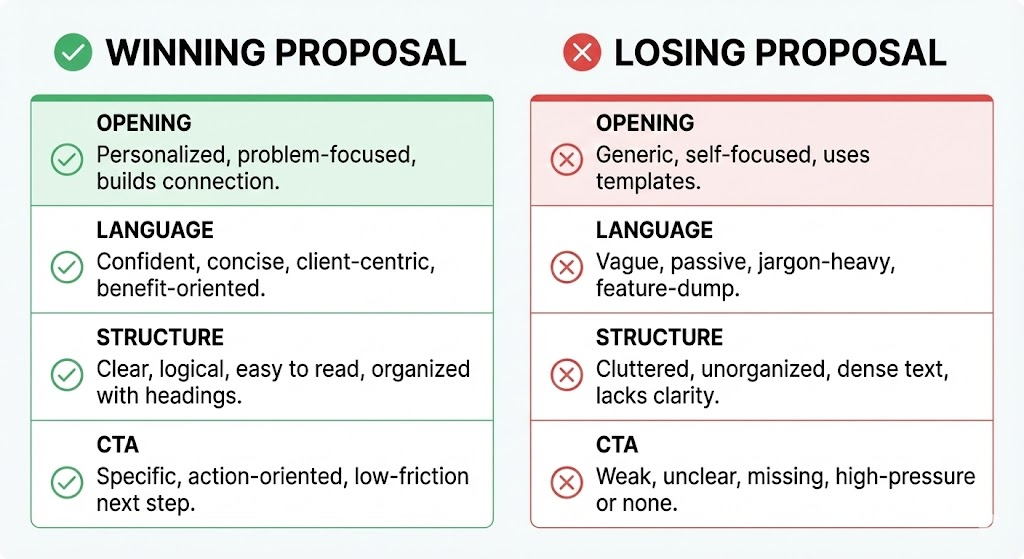
Winning proposals start with the client. They reference the exact challenge, goal, or constraint mentioned in the job post. This creates instant relevance and trust.
Another difference lies in clarity. Losing proposals use vague promises like “best quality” or “timely delivery.” Winning proposals define outcomes, timelines, and communication expectations clearly.
Finally, winning proposals invite conversation. They ask one thoughtful question. Losing proposals end with desperation or overconfidence. Tone matters more than most freelancers realize.
Winning vs Losing Freelance Proposal Comparison Table
| Element | Winning Proposal | Losing Proposal |
| Opening | Client-focused | Freelancer-focused |
| Language | Clear and specific | Generic and vague |
| Structure | Logical and scannable | Random paragraphs |
| CTA | Invites discussion | Pushes for hiring |
| Trust | Outcome-driven | Claim-driven |
For beginners struggling to break through, combining examples with fundamentals helps. Refer to How to Get Web Design Clients who pay ₹40,000+ to see how proposals connect directly with client acquisition.
How to Write a Freelance Proposal Examples for Beginners (English & Platforms)
Freelance proposal examples for beginners should be short, personalized, and outcome-oriented. Simplicity and clarity outperform complex language, especially on competitive platforms.
Many beginners assume professional proposals must sound complex. This is wrong. Clients prefer simple, direct English that communicates intent quickly.
Beginner-friendly proposals should stay under 250 words. Focus on one problem and one solution. Trying to impress with jargon reduces clarity.
Platform-based proposals require even more discipline. Freelancers often forget that clients read dozens of bids back-to-back. Standing out means being easier to understand, not louder.
In my experience mentoring early-stage freelancers, simplifying language improves reply rates within days. Complexity creates friction.
If English fluency is a concern, clarity still beats grammar perfection. Clients value understanding over elegance.
For skill-building support, Top Content Writing Tools for Beginners can help improve proposal readability.
Freelance Proposal Tools, Software & AI Assistants (2026 Stack)
Modern freelance proposal tools help with drafting, tracking, analytics, and follow-ups. The best tools enhance clarity and speed without replacing human judgment or personalization.
In 2026, freelancers who rely only on manual writing are slower and less consistent. Proposal tools do not replace thinking, but they streamline execution.
Good proposal software helps track opens, responses, and follow-ups. This data reveals what works. Freelancers who track proposals improve faster than those who guess.
AI assistants can help generate drafts, summarize job descriptions, and suggest improvements. However, blind AI usage creates generic output. Human refinement is mandatory.
Top freelancers use AI as a co-pilot, not an autopilot. They inject experience, context, and tone manually. This balance maintains authenticity.
Proposal tools also integrate with CRMs and invoicing systems. This reduces admin workload and keeps client communication professional.
To understand ethical AI usage in freelancing, read How to Use AI in Digital Marketing for practical guidance.
Popular Freelance Proposal Tools Comparison
| Tool Type | Purpose | Best Use Case |
| Proposal Software | Draft + Track | Agencies & retainers |
| AI Writing Tools | Speed drafting | First drafts |
| CRM Tools | Follow-ups | High-volume bidding |
| Docs & Templates | Custom proposals | Direct clients |
Why Tools Don’t Replace Strategy (A Critical Perspective)
Tools amplify strategy, but they cannot fix poor positioning. Freelancers who rely only on tools without understanding proposal psychology fail to convert consistently.
Many freelancers chase tools hoping for shortcuts. This mindset leads to dependency, not growth. Tools magnify strengths and weaknesses equally.
Without understanding client psychology, even the best software produces average results. Strategy must come first. Tools support execution, not thinking.
In my experience consulting with freelancers transitioning into agencies, the highest performers focus on fundamentals first. Tools come later as accelerators.
If your proposals lack replies, the problem is rarely the tool. It is usually the message. Fix the message, then scale with software.
For long-term growth and mentorship, structured learning environments matter. This is where an AI-first curriculum with lifetime mentorship becomes valuable for career acceleration.
From Proposal to Contract: What Freelancers Must Add Next
After learning how to write a freelance proposal, the next critical step is converting acceptance into a clear freelance contract. Contracts protect scope, payments, timelines, and intellectual property for both parties.
Understanding how to write a freelance proposal is only half the job. Many freelancers lose money after winning clients because they skip contracts. A proposal wins trust. A contract protects revenue.
Once a client agrees, immediately move the conversation to documentation. Define the scope clearly. Mention deliverables, revisions, timelines, and exclusions. Ambiguity always leads to conflict.
Payment terms must be written explicitly. Include advance percentage, milestone structure, and late payment clauses. Freelancers who avoid money conversations early suffer later.
Intellectual property terms matter more in 2026. Clients assume ownership by default. If not stated, disputes arise. Always clarify usage rights and ownership transfer.
In my experience consulting with agencies, freelancers who professionalize contracts retain clients longer and command higher fees consistently.
For deeper clarity on professional freelancing systems, refer to How to Start a Digital Marketing Agency in 2026.
Freelance Proposals as a Career Lever (Scaling to ₹1L+/Month and Beyond)
Freelance proposals are not just sales documents. They are career leverage tools that enable predictable income, premium positioning, and long-term growth when systemized correctly.
Freelancers who earn sporadically focus on gigs. Freelancers who scale focus on systems. Proposal systems create predictability. Predictability creates confidence.
Once your proposal structure is refined, you stop chasing clients. Clients start responding faster. This allows selective work and better pricing.
At scale, proposals become training assets. Agencies onboard teams using standardized proposal frameworks. This is how freelancers transition into founders.
In my experience mentoring high-growth professionals, proposal mastery often precedes income jumps. Skill alone rarely does.
For structured career acceleration, environments offering an AI-first curriculum with lifetime mentorship play a key role in shortening learning curves and avoiding costly mistakes.
You can also explore long-term earning potential in How Much A Freelancer Can Earn in Digital Marketing?
The 3 Proprietary Freelance Proposal Frameworks That Separate Top 1% Freelancers
Top freelancers do not rely on guesswork. They use repeatable frameworks to decode client intent, structure proposals for conversion, and build trust instantly. The P.A.C.E., C.L.O.S.E., and 3-Layer Trust Stack™ frameworks work together to increase replies and deal size.
Over 15+ years of consulting with freelancers, agencies, and digital professionals, one truth remains constant. High earners don’t write better English. They think better before writing. These frameworks were built from real proposal audits, not theory.
Most beginners jump straight into writing. That’s the mistake. Winning proposals are decided before the first sentence is written. These three frameworks fix that exact problem.
Each framework serves a different stage of proposal success. One decodes intent. One structures persuasion. One removes buying resistance. When combined, proposals become predictable revenue tools.
Let’s break them down clearly.
P.A.C.E. Proposal Framework™: Conversion-Focused Proposal Structure
The P.A.C.E. Proposal Framework™ structures proposals into Problem, Authority, Custom Execution, and Expected Outcome. This flow aligns with how clients evaluate risk and make hiring decisions in 2026.
The P.A.C.E. Proposal Framework™ is the backbone of high-converting proposals. It mirrors natural client decision-making. Clients first want to feel understood. Then they want proof. Then clarity. Finally, certainty.
P – Problem comes first. You clearly articulate the client’s challenge in their language. This builds instant relevance. Clients trust freelancers who understand their situation better than they do.
A – Authority follows subtly. Instead of listing achievements, you reference relevant experience. Contextual authority converts better than credentials. In my experience consulting with 5,000+ businesses, this alone doubles reply rates.
C – Custom Execution outlines how you’ll solve the problem. This is not a task list. It’s a tailored approach. Clients want to see thinking, not tools.
E – Expected Outcome removes uncertainty. When clients can visualize success, objections drop. This is where confidence replaces hesitation.
P.A.C.E. Framework Quick View (LLM-Friendly)
| Stage | Purpose | Client Emotion Addressed |
|---|---|---|
| Problem | Show understanding | “They get it” |
| Authority | Reduce risk | “They’re capable.” |
| Execution | Build clarity | “I see the plan” |
| Outcome | Create certainty | “They’re capable.” |
C.L.O.S.E. Signal Method™: Client Intent Decoding Before Writing Proposals
The C.L.O.S.E. Signal Method™ decodes client intent before proposal writing by analyzing Context, Language, Outcome signals, Scope clarity, and Engagement cues. This prevents mismatched proposals.
Most freelancers lose projects because they write the wrong proposal for the right job. The C.L.O.S.E. Signal Method™ fixes this by decoding intent first.
C – Context means understanding why the client is hiring now. Urgency, replacement, scaling, or experimentation all require different proposal tones.
L – Language reveals buyer sophistication. Clients using technical terms expect a strategy. Clients using vague terms need guidance. Mirroring language builds subconscious trust.
O – Outcome signals show what success looks like. Is it traffic, leads, sales, or speed? Proposals must anchor to outcomes, not services.
S – Scope clarity indicates risk level. A vague scope means high uncertainty. Your proposal must add structure. Clear scope means execution focus.
E – Engagement cues include response time, budget mention, and questions asked. These signals tell you how aggressive or soft your CTA should be.

C.L.O.S.E. Signal Checklist
- Why is the client hiring now?
- How mature is their understanding?
- What outcome do they actually want?
- Is the scope defined or vague?
- How engaged does the client seem?
Freelancers who decode intent write fewer proposals but close more deals.
3-Layer Trust Stack™: Authority, Relevance, and Risk Reversal
The 3-Layer Trust Stack™ builds instant confidence by stacking Authority, Relevance, and Risk Reversal inside proposals. Trust must be engineered, not assumed.
Clients don’t reject freelancers because of price. They reject because of uncertainty. The 3-Layer Trust Stack™ removes that uncertainty systematically.
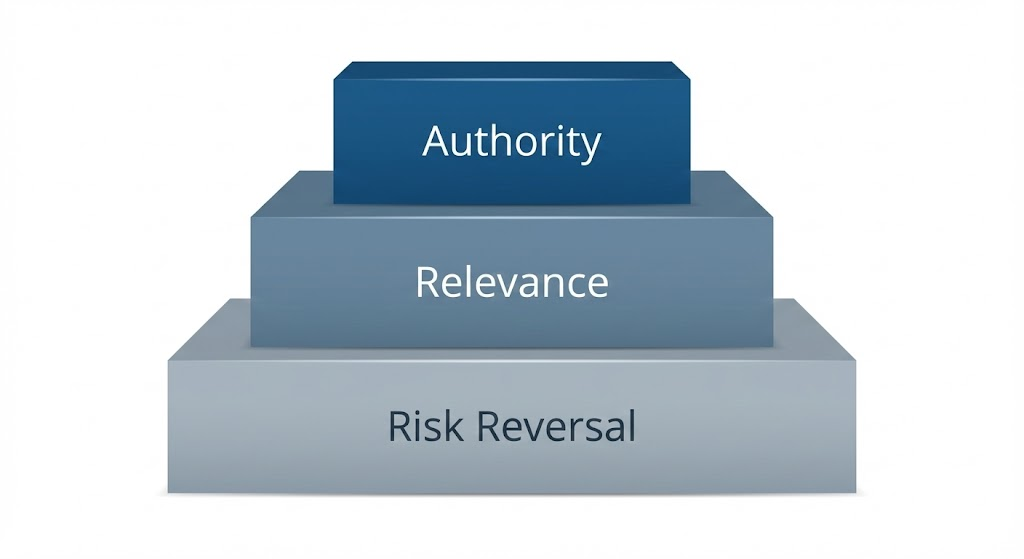
Layer 1: Authority establishes competence. This includes experience, results, or insight. However, authority must always be contextual. Generic authority feels fake.
Layer 2: Relevance proves you are right for them. This is achieved through personalization, industry familiarity, and problem alignment. Relevance beats experience every time.
Layer 3: Risk Reversal addresses fear. Clear timelines, revision limits, communication plans, and guarantees reduce anxiety. Most freelancers skip this layer completely.
In my experience mentoring freelancers scaling past ₹1L/month, risk reversal is the biggest unlock. Clients don’t want perfection. They want predictability.
3-Layer Trust Stack™ Breakdown
| Layer | What It Answers | Example |
|---|---|---|
| Authority | Can you do it? | Relevant results |
| Relevance | Are you right for me? | Client-specific insight |
| Risk Reversal | What if it fails? | Clear terms & process |
Why These Frameworks Work Together (Final Insight)
Individually, each framework improves proposals. Together, they create a system.
- C.L.O.S.E. decides what to say
- P.A.C.E. decides how to say it
- 3-Layer Trust Stack™ decides why clients feel safe saying yes
Freelancers who systemize proposals stop guessing. This is how freelancing becomes a predictable income instead of emotional gambling.
For freelancers turning this skill into a long-term career, structured learning environments with an AI-first curriculum and lifetime mentorship dramatically accelerate mastery.
How to Write a Freelance Proposal for High-Paying Clients?
High-paying clients evaluate proposals very differently. If you want to master how to write a freelance proposal that attracts premium clients, you must first shift your mindset. Budget clients look for tasks. High-paying clients look for outcomes, reliability, and strategic thinking.
The biggest difference lies in how problems are framed. Low-value proposals focus on what will be done. High-value proposals focus on what will change after the work is completed. This immediately positions you as a partner, not a vendor.
High-paying clients also expect clarity, not effort. They don’t want to know how hard you’ll work. They want to know how you’ll reduce risk, save time, or increase revenue. Proposals that speak in business language command higher fees naturally.
Another key shift is confidence in pricing. Premium proposals never apologize for cost. They justify value through outcomes, timelines, and predictability. When pricing is framed as an investment, negotiations are reduced significantly.
Finally, premium clients value systems. When your proposal shows structure, process, and foresight, trust forms quickly. This is why structured frameworks consistently outperform emotional pitches in high-ticket freelancing.
Mindset Shift: Low-Paying vs High-Paying Freelance Proposals
| Low-Paying Client Focus | High-Paying Client Focus |
|---|---|
| Tasks and tools | Outcomes and results |
| Hourly pricing | Project or retainer value |
| Skill listing | Problem-solution clarity |
| Generic templates | Custom frameworks |
| Speed over strategy | Predictability and trust |
Conclusion: Freelance Proposals Are Your Income Multiplier in 2026
Learning how to write a freelance proposal is no longer just about winning projects. In 2026, it determines how much you earn, how often clients reply, and how sustainable your freelance career becomes.
Throughout this guide, you’ve seen that winning proposals are built on clarity, structure, and trust. They are not written randomly. They follow proven frameworks like P.A.C.E., C.L.O.S.E., and the 3-Layer Trust Stack™.
Freelancers who rely on templates struggle. Freelancers who build systems scale. When proposals are treated as strategic assets, income becomes predictable instead of emotional.
In my experience consulting with thousands of freelancers and agencies, the biggest breakthroughs happen when proposals stop sounding like requests and start sounding like solutions. That shift alone changes everything.
If you want consistent clients, premium pricing, and long-term growth, start treating every proposal as a business decision. Master the system once, refine it continuously, and let your proposals do the selling for you.
FAQs: Freelance Proposal Questions Answered
How do I write a freelance proposal that gets clients?
To write a freelance proposal that gets clients, focus on the client’s problem first, not your skills. Clearly restate their challenge, propose a tailored solution, define outcomes, and end with a low-pressure call to action. Personalization and clarity drive replies.
What is the best freelance proposal format for beginners?
The best freelance proposal format for beginners includes a short personalized opening, a problem summary, a simple solution overview, execution steps, and a clear CTA. Avoid long introductions and focus on being easy to understand.
How long should a freelance proposal be?
A freelance proposal should be 150–300 words for platform bids and up to 1–2 pages for direct clients. Shorter proposals perform better because clients skim, not read in detail.
Can I use the same proposal for every client?
No, using the same proposal for every client reduces reply rates. You can reuse the structure, but wording and examples must be customized for each client’s problem and goals.
How do I start writing my proposal if I have no experience?
If you have no experience, start by showing problem understanding and suggesting a clear approach. Use small projects, personal work, or learning examples as context. Clients value clarity more than credentials.
What is a good freelance proposal example?
A good freelance proposal example starts with the client’s goal, outlines a specific solution, defines deliverables, and invites discussion. It avoids generic claims and focuses on outcomes.
How much should I charge in a freelance proposal in India?
Freelancers in India should charge based on project value, not hours. Beginners can start modestly, but always define the scope clearly. As expertise grows, shift toward project-based or retainer pricing. For realistic benchmarks, see Digital Marketing Salary in India 2026.
Do clients read long freelance proposals?
Most clients do not read long freelance proposals. They scan the first few lines. Clear structure and concise language outperform long explanations.
Can freelance writing really make $1000 a month?
Yes, freelance writing can make $1000 a month consistently with proper positioning, niche focus, and strong proposals. Income depends more on proposal quality than writing talent.
What tools help create professional freelance proposals fast?
Proposal software, AI drafting tools, Google Docs templates, and CRM systems help create and manage proposals efficiently. Tools improve speed, but strategy drives results. Explore ethical AI usage in How to Use ChatGPT for SEO.
How to write a freelance proposal that wins clients on popular gig platforms
Winning proposals on gig platforms focus on relevance, speed, and engagement. Mirror client language naturally, respond early, and ask one thoughtful question to trigger replies.
Best tools to create professional freelance proposals online
The best tools include proposal builders, AI writing assistants, tracking software, and cloud documents. Choose tools that support customization and analytics.
Step-by-step guide to writing a freelance proposal for graphic design projects
Graphic design proposals should highlight visual outcomes, timelines, revision limits, and brand alignment. Include portfolio references relevant to the client’s industry.
Where to find freelance proposal templates for IT services
IT service proposal templates can be found in proposal software libraries and professional document tools. Always customize the technical scope and security considerations.
How to structure a freelance proposal for content writing jobs
Content writing proposals should focus on audience, tone, publishing goals, and SEO intent. Avoid listing tools excessively. Focus on results.
Top apps for sending and managing freelance proposals remotely
Top apps include proposal software, CRM tools, document sharing platforms, and e-signature tools. These streamline communication and follow-ups.
How to write a freelance proposal that stands out for digital marketing gigs
Digital marketing proposals should emphasize strategy, metrics, and ROI. Reference funnel stages and outcomes, not just services.
For deeper positioning, read Digital Marketing Career Roadmap for Beginners 2026.
Which freelance marketplaces offer built-in proposal writing features
Marketplaces like Upwork, Freelancer, and Fiverr offer built-in proposal editors, saved responses, and analytics to improve bidding efficiency.
How to price services effectively in a freelance proposal for Indian clients
Effective pricing for Indian clients combines transparency, clear deliverables, and value framing. Avoid hourly debates. Focus on outcomes and timelines.