
In 2026, freelancing is no longer about finding work. It is about understanding how to create a portfolio for freelancer success in an overcrowded digital economy.
Over the last 15 years, while consulting with over 5,000 businesses and mentoring more than 50,000 learners globally, I have observed one pattern that repeats consistently.
Skilled freelancers struggle not because they lack ability, but because they fail to present their value convincingly through a well-structured portfolio.
A freelancer’s portfolio today is not a static showcase. It is the practical result of knowing how to create a portfolio for freelancer credibility, trust, and conversion.
With AI-driven hiring, smarter clients, and outcome-focused decision-making, portfolios have replaced resumes entirely. Clients want visible proof, strategic clarity, and confidence before they even schedule a call.

This is why understanding how to create a portfolio for freelancer success has become a foundational career skill.
Many professionals begin this journey by first understanding the fundamentals of how to become a freelancer in a competitive digital economy
What Is a Freelancer Portfolio and Why Does It Matter in 2026?
What Is a Freelancer Portfolio?
A freelancer portfolio is a strategically designed digital presentation of your skills, experience, work samples, and results, created to convince potential clients to hire you.
Unlike a resume, which lists qualifications, a freelance portfolio demonstrates real capability and problem-solving ability.
In modern freelancing, portfolios act as decision accelerators. Clients use them to evaluate trustworthiness, expertise, and relevance within minutes.
This applies equally to a freelance portfolio for beginners, experienced consultants, and specialists operating in competitive niches like writing, design, or digital marketing.
A strong freelancer website portfolio clearly communicates who you help, what problems you solve, and what outcomes you deliver.
When done correctly, it filters low-paying clients and attracts serious inquiries.

Why Freelance Portfolios Are More Important Than Skills Alone?
Skills without proof no longer convert. In 2026, clients are outcome-driven. They want to see how your work impacts revenue, traffic, engagement, or growth.
Through my consulting work, I have observed that freelancers with average skills but strong portfolios consistently outperform highly skilled freelancers with weak presentation.
Google’s Search Quality Rater Guidelines emphasize trust, experience, and helpfulness. The same psychology applies to human decision-making.
A portfolio filled with clarity, context, and results builds instant confidence.
This outcome-focused approach is especially relevant for those exploring what is freelance digital marketing
The same applies to a freelance designer’s portfolio that explains design logic rather than just visuals.

How Freelancer Portfolios Influence Pricing and Client Quality?
One of the biggest misconceptions is that pricing depends only on experience.
In reality, pricing depends on perceived value. Your portfolio directly controls that perception. Freelancers earning ₹1 lakh per month or more are not necessarily more skilled.
They are better positioned.
A strategically built freelance portfolio allows you to:
- Justify premium pricing
- Attract repeat clients
- Reduce negotiation friction
- Shorten sales cycles
This concept aligns closely with principles explained in What is Freelance Digital Marketing? A Beginner’s Guide, where positioning and proof play a central role in long-term income growth.
Portfolio as a Long-Term Career Asset
Unlike social media profiles or marketplace accounts, your freelancer website portfolio is an owned asset. It compounds value over time. Each project strengthens credibility.
Each testimonial improves conversions. Each optimized page increases organic visibility.
Freelancers who invest early in building a solid portfolio gain a competitive advantage that becomes difficult to replicate later.
This is especially important as AI-driven hiring tools increasingly scan portfolios for relevance, clarity, and authority.
- Understand portfolio as a conversion tool, not a gallery
- Focus on outcomes, not just skills
- Treat your portfolio as a long-term business asset
- Align content with trust, clarity, and usefulness
How to Create a Portfolio for Freelancer Step by Step?
The PACT Framework for Freelance Portfolios
Over years of mentoring freelancers globally, I developed a simple but effective framework called PACT:
- Positioning
- Audience clarity
- Case-driven proof
- Trust signals
This framework works across industries and experience levels. It is especially effective for those learning how to create a portfolio for freelancer in competitive markets.
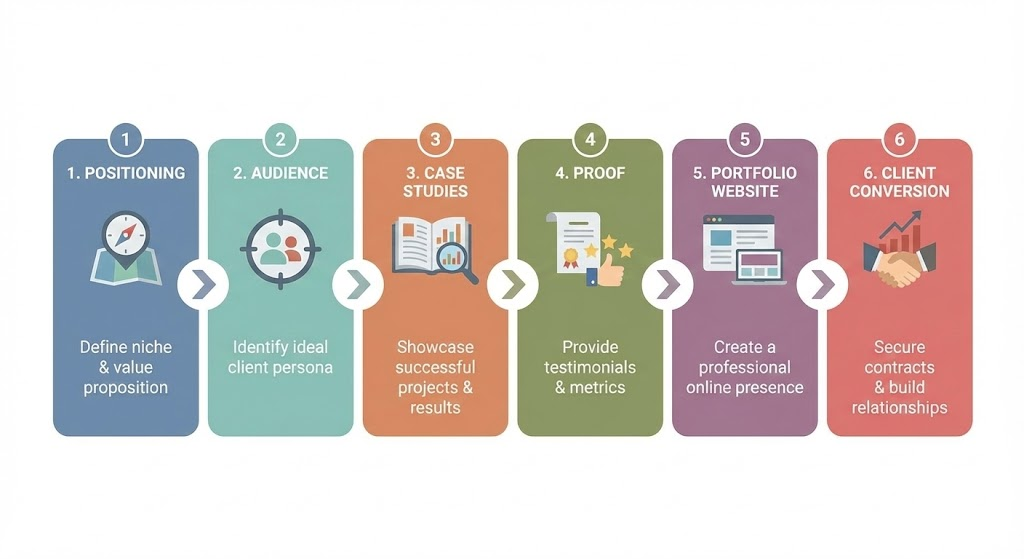
Step 1: Define Clear Freelance Positioning
Positioning answers one critical question:
Why should a client hire you instead of anyone else?
Generic statements like “I am a freelancer who does everything” immediately reduce credibility. Instead, define a narrow and specific value proposition.
A strong positioning statement includes:
- Target audience
- Core problem
- Primary outcome
For example, “I help ecommerce brands increase conversion rates using CRO-driven design” is far more effective than “I design websites.”
This concept is also reinforced in How to Get Web Design Clients who Pay ₹40,000+, where clarity directly impacts deal size.
Step 2: Identify Your Ideal Client Persona
Your portfolio should speak to one audience, not everyone.
When freelancers attempt to attract all clients, they attract none. Clear audience definition improves messaging, examples, and trust alignment.
Key factors to define include:
- Industry
- Business size
- Budget expectations
- Pain points
A freelance digital marketing portfolio targeting startups will look very different from one targeting established ecommerce brands. Language, metrics, and tools should reflect this difference clearly.
Step 3: Select Relevant Work Samples
More samples do not mean better portfolios. Relevance matters more than quantity.
Three strong, well-explained projects outperform ten weak or unrelated samples.
Each project should clearly show:
- The problem
- Your approach
- Tools used
- Results achieved
This mirrors the case-study-based approach explained in How to Create a Digital Marketing Portfolio, where storytelling and outcomes drive conversions.
Step 4: Design a Conversion-Focused Flow
Your portfolio should guide visitors logically. Every section must answer a silent client question. Avoid clutter, distractions, and unnecessary jargon.
A strong flow includes:
- Clear headline
- Value proposition
- Proof
- Call to action
Remember, a freelancer’s portfolio is not about impressing peers. It is about converting clients.
How to Create a Portfolio as a Beginner with No Clients?
One of the most common concerns among aspiring freelancers is the lack of paid work experience. From a practical standpoint, this concern is valid.
However, from a hiring perspective, it is often misunderstood. Clients do not hire freelancers based on how long they have worked. They hire based on how clearly a freelancer demonstrates problem-solving ability.
Over years of mentoring beginners entering freelancing, I have consistently seen that clients care more about capability proof than employment history.
A well-structured freelance portfolio for beginners can outperform an experienced freelancer’s portfolio if it shows clarity, intent, and competence.
Many beginners accelerate faster when they follow structured approaches, similar to how to start freelancing in digital marketing.
Beginners must shift their mindset from “I have no clients” to “I can demonstrate value.” Your portfolio does not need paid projects initially. It needs relevant, well-explained, and strategically positioned work.
How Beginners Can Create Portfolio Projects Without Clients?
When you lack real clients, you create realistic work simulations. This approach is not theoretical. It is actively used in professional training environments and hiring evaluations.
Simulated projects show thinking, execution, and industry awareness.
Beginners can create strong portfolio projects by redesigning existing websites, writing sample content for known brands, or creating mock marketing campaigns with clear objectives.
For example, a beginner building a digital marketing freelancer portfolio can create a campaign plan for a local business and explain expected KPIs, tools, and strategies.
This method closely aligns with skill-building strategies explained in How to Learn Digital Marketing in 30 Days, where structured practice replaces passive learning.
The key is honesty. Clearly label projects as self-initiated or practice-based. Transparency builds trust, while clarity builds confidence.
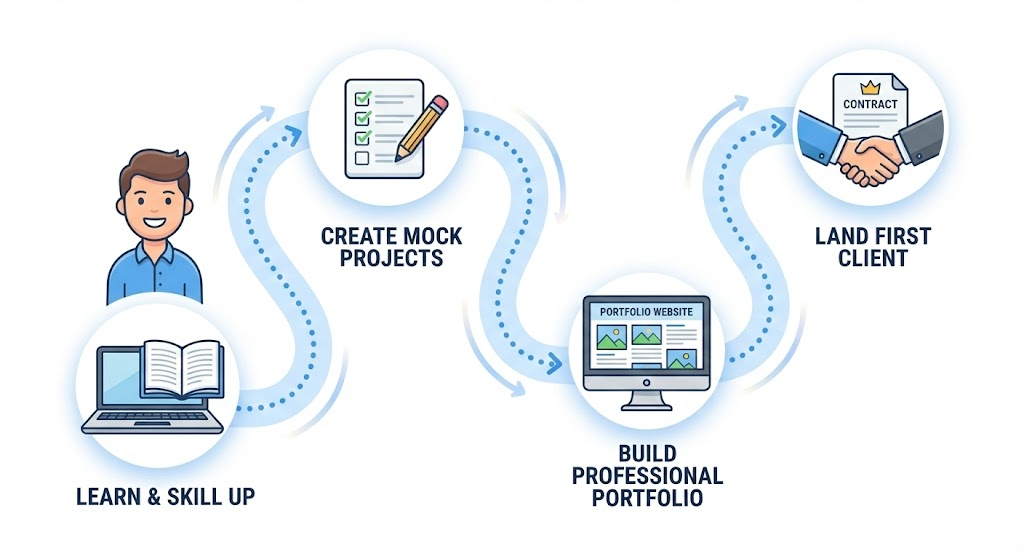
Using Unpaid, Internship, or Practice Work Strategically
Unpaid work is often misunderstood. It should never be exploited, but it can be used strategically early in a freelance career. Internships, mentorship-based projects, and collaboration work provide real-world exposure and testimonials.
For beginners, even small contributions matter if documented correctly.
A single landing page optimization, a blog content series, or a social media campaign can be turned into a strong case study if the process and outcomes are explained clearly.
This documentation-first approach is frequently emphasized in How to Get a Digital Marketing Internship in 5 Simple Steps,
Your portfolio should show progression.
Clients appreciate freelancers who invest in learning and improving systematically.
How to Structure Beginner Case Studies Properly?
A common mistake beginners make is uploading work samples without context. Context is what turns a sample into a case study. Each project in a beginner freelance portfolio should follow a consistent structure.
Explain the problem, the chosen strategy, the tools used, and the expected or achieved outcome. Even if the project is simulated, explain your decision-making process.
This shows maturity and professionalism beyond experience level.
This approach mirrors hiring expectations discussed in Roles and Responsibilities of a Digital Marketer, where employers assess thinking, not just output.
Structured case studies also help AI systems understand and categorize your expertise accurately.
Beginner Portfolio Positioning Tips That Actually Work
Beginners often attempt to appear advanced by using complex language or listing too many services. This usually backfires. Clear, honest positioning performs better than exaggerated claims.
If you are new, position yourself as a focused specialist-in-training rather than a generalist expert.
For example, a beginner working on creating a freelance writing portfolio can focus on one niche, like SAAS blogs or ecommerce product descriptions, instead of claiming broad expertise.
This clarity improves both client trust and SEO relevance.
It also aligns with Google’s Helpful Content standards, which reward authenticity and usefulness.
- Create 3 to 5 self-initiated or simulated projects
- Clearly explain the process and strategy
- Be transparent about experience level
- Focus on one niche or service
- Document learning and outcomes
Must-Have Sections in a High-Converting Freelance Portfolio
A high-converting freelance portfolio follows a deliberate structure. Every section exists for a reason.
Over years of portfolio reviews, I have noticed that portfolios fail not because of weak work, but because of missing or poorly structured sections.
A portfolio must guide the visitor logically, building trust step by step. Each section should answer a specific client question and reduce decision friction.
Whether you are building a freelancer website portfolio or using a platform, structure determines conversion.
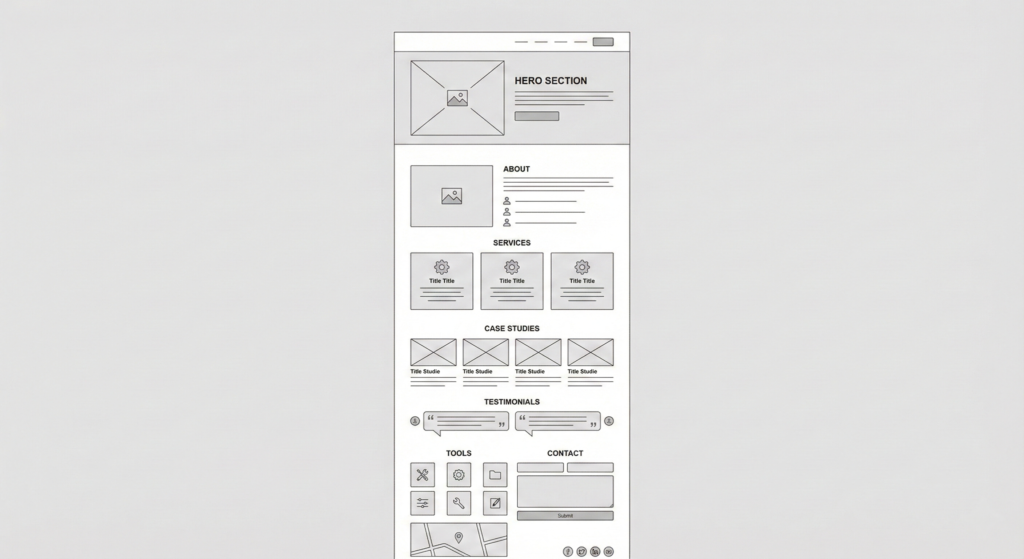
Hero Section: Clarifying Value Instantly
The hero section is the most critical part of your portfolio. Within five seconds, a visitor should understand who you help and what outcome you provide.
Vague introductions reduce engagement immediately.
A strong hero section includes a clear headline, a short value proposition, and a primary call-to-action. Avoid listing skills here. Focus on outcomes and specialization.
This is especially important for a freelance portfolio website, where bounce rates directly impact SEO.
This clarity-driven approach aligns with conversion principles discussed in How to Improve Marketing ROI Like a Pro, where messaging clarity drives action.
About Section: Building Human Trust, Not Biography
The about section is not your life story. It is a credibility bridge. Clients want to understand your background, approach, and working philosophy. Keep it concise but meaningful.
Mention your experience, learning journey, and professional focus.
If relevant, briefly mention mentorship, training, or exposure to real-world projects. For beginners, this is where honesty matters most.
This approach mirrors trust-building strategies highlighted in the Digital Marketing Career Roadmap for Beginners.
Services Section: Outcome-Focused, Not Feature-Heavy
Your services section should explain how your work helps clients achieve results. Avoid technical jargon. Instead, focus on transformation.
For example, instead of “SEO services,” explain “SEO strategies that improve organic traffic and lead quality.” This approach works across niches, whether you are a writer, designer, or marketer.
This is particularly important for a freelance digital marketing portfolio, where services often overlap and clarity differentiates professionals.
Work Samples and Case Studies Section
This section forms the backbone of your portfolio. Each project should demonstrate relevance, problem-solving, and execution. Explain what you did, why you did it, and what impact it created.
Case studies should be scannable but detailed. Use headings, short paragraphs, and clear outcomes. This structure helps both human readers and AI systems understand your expertise.
For deeper insights into this approach, refer to 6 Powerful Tips on How to Create a Digital Marketing Portfolio.
Contact and Call-to-Action Section
A surprising number of freelancers forget this section. Make it easy for clients to contact you. Include email, contact form, or booking link.
Your CTA should be simple and direct. Avoid aggressive language. Invite conversation, not pressure.
Freelance Portfolio Website vs Platforms: What Works Best in 2026?
One of the most strategic decisions freelancers face is choosing between a freelance portfolio website and third-party platforms.
In 2026, this choice will have a direct impact on visibility, trust, pricing power, and long-term career stability.
While both options can generate leads, they serve very different purposes in a freelancer’s growth journey.
From years of consulting freelancers across markets, the highest earners rarely depend on a single channel. Instead, they use platforms for discovery and their portfolio website for authority.
Understanding how these two models function helps you design a portfolio that attracts quality clients rather than price-sensitive ones.
A freelancer’s portfolio should be treated as a business asset. Platforms can support that asset, but they should not replace it.
Using Freelance Platforms as a Starting Point
Freelance marketplaces like Upwork, Fiverr, and Freelancer offer visibility to beginners.
They reduce initial friction by providing traffic, payment systems, and basic credibility signals. For those learning how to start a freelancing portfolio, platforms often feel like the easiest entry point.
However, platforms operate on competition and price comparison. Clients browse multiple profiles quickly and make decisions based on ratings, response speed, and cost.
This environment limits how deeply you can communicate value, especially for specialized services.
Many beginners stall at this stage because their growth becomes platform-dependent. This pattern is frequently observed among freelancers discussed in Benefits of LinkedIn for Freelancers, where visibility improves but authority remains limited.
Platforms are useful, but they should not be the end goal.
Why a Freelance Portfolio Website Builds Long-Term Authority?
A freelance portfolio website gives you complete control over messaging, structure, and positioning.
It allows you to explain your services in depth, present case studies properly, and optimize for search engines and AI discovery systems.
Unlike platforms, your website is not competing visually with hundreds of other freelancers.
Visitors focus entirely on your story, your work, and your value. This increases trust and conversion potential significantly, especially for premium services.
From an SEO perspective, a well-optimized freelancer website portfolio can rank organically for niche queries over time.
This creates a consistent inbound lead channel without platform fees or bidding wars.
This long-term visibility aligns closely with strategies discussed in How You Can Increase Your Organic Search Ranking.
Best Approach: Platform Plus Portfolio Website
The most effective freelancers combine both approaches strategically. Platforms are used for lead generation and testimonials, while the portfolio website acts as a credibility and conversion hub.
For example, a freelancer may connect with a client on Upwork, but redirect them to a personal portfolio website for deeper evaluation.
This instantly elevates perception and differentiates you from competitors.
This hybrid approach is particularly effective for professionals building a freelance digital marketing portfolio, where trust and proof matter more than price.
Affordable Website Builders for Freelancers in India
Cost should never be a barrier. Several affordable website builders make it easy to launch a professional portfolio website.
WordPress remains the most flexible option for long-term SEO. Wix and Webflow offer simplicity and speed for beginners.
What matters most is clarity, structure, and performance. Avoid over-designing. Focus on fast loading, mobile responsiveness, and simple navigation.
This practical mindset mirrors recommendations found in How to Start a Digital Marketing Career in India as a Fresher, where foundational assets matter more than advanced tools.
- Use platforms for early exposure
- Build a personal portfolio website for an authority
- Avoid dependency on a single channel
- Choose simple, scalable website tools
- Focus on clarity and trust over design complexity
Niche-Specific Freelance Portfolio Examples That Convert
A common reason portfolios fail is a lack of niche focus. Generic portfolios attract generic clients. Niche-specific portfolios speak directly to a client’s context, pain points, and expectations.
In 2026, specialization is no longer optional.
When clients visit a portfolio, they subconsciously ask, “Have you solved my kind of problem before?” A niche-focused portfolio answers this instantly.
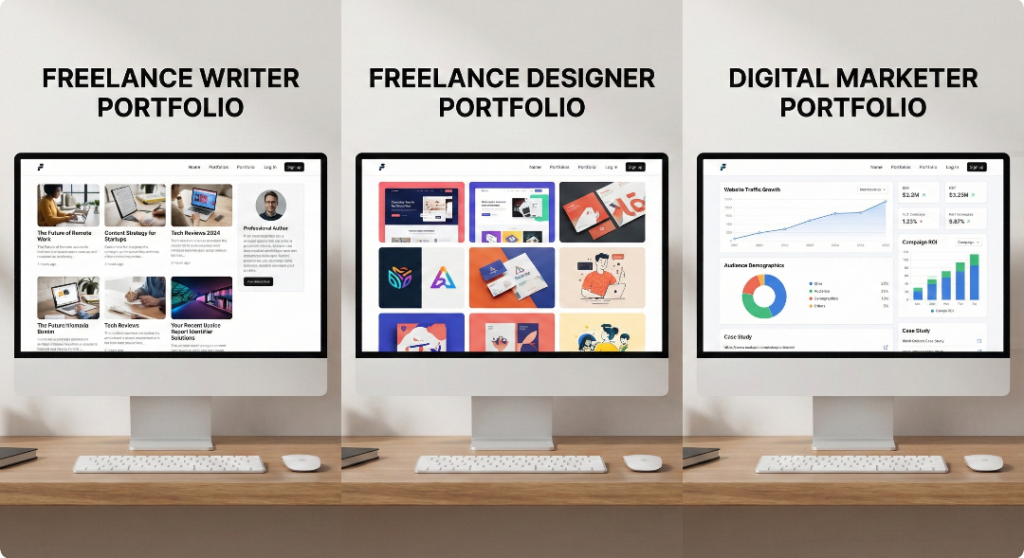
Creating a Freelance Writing Portfolio That Attracts Clients
A strong freelance writing portfolio does more than display writing samples. It demonstrates understanding of audience intent, content goals, and business outcomes.
This is particularly crucial for those seeking to build a freelance writing portfolio in competitive markets.
Each sample should explain the content objective, target audience, and expected result. Writers should categorize samples by niche, such as SaaS, ecommerce, or B2B services. This improves relevance and trust.
This content-driven positioning aligns with insights from Top Content Writing Tools for Beginners, where process clarity matters as much as output.
Building a Freelance Designer Portfolio with Strategic Context
A freelance designer portfolio should not be a gallery of visuals alone. Clients want to understand the thinking behind the design. Each project should explain the client’s goal, design challenge, and solution approach.
Including before-and-after visuals, wireframes, or user flow explanations significantly increases credibility.
This approach helps clients see design as a business tool, not just aesthetics.
Designers who adopt this method tend to attract higher-paying clients and long-term contracts.
Digital Marketing Freelancer Portfolio: What Clients Expect
Many professionals use such portfolios as entry points for consistent work, following strategies outlined in how to get freelance digital marketing projects.
Clients expect metrics, KPIs, and performance indicators. Simply listing services like SEO or ad management is not enough.
Each case study should highlight goals, strategy, tools used, and measurable impact. Even beginner marketers can show simulations, audits, or learning-based campaigns with proper explanation.
This outcome-focused approach directly connects with strategies discussed in Top In-Demand Digital Marketing Skills You Can’t Ignore in 2026.
Customizing Portfolios for Different Freelance Niches
While structure remains consistent, language and proof change across niches. Writers emphasize clarity and engagement. Designers emphasize usability and visual logic.
Marketers emphasize performance and ROI.
Understanding this nuance is critical when learning how to create a portfolio for freelancer roles across different domains. Customization increases relevance, which increases conversion.
Adding Proof, Testimonials, and Results to a Freelance Portfolio
Proof is the single most powerful conversion element in a freelancer’s portfolio.
In 2026, clients are more skeptical than ever. Certifications, claims, and tools no longer convince decision-makers. What converts is visible evidence that your work delivers outcomes.
A strong freelance portfolio replaces assumptions with clarity.
It shows not only what you did, but why it mattered. Proof reduces perceived risk, which directly increases inquiry rates and pricing acceptance.
Over years of consulting freelancers across industries, I have observed that portfolios with authentic proof outperform visually superior portfolios without proof by a wide margin.
What Type of Proof Works Best in a Freelancer Portfolio?
Not all proof is equal. Generic testimonials like “Great work” or “Very professional” add limited value. High-converting proof explains impact, relevance, and credibility.
Effective proof includes measurable results, clear context, and identifiable sources. Screenshots of analytics, before-and-after comparisons, and outcome-focused testimonials build immediate trust.
This applies across niches, whether it is a freelance designer portfolio or a freelance digital marketing portfolio.
This focus on real-world outcomes closely aligns with principles discussed in How to Improve Marketing ROI Like a Pro, where results drive decisions.
How Beginners Can Add Proof Without Paid Clients?
Lack of clients does not mean lack of proof. Beginners can document practice projects, internships, simulations, or collaborative work. The key is to explain intent, strategy, and learning outcomes transparently.
For example, a beginner marketer can include a website audit with identified issues and proposed improvements. A writer can include content samples with audience intent and SEO structure explained.
This learning-based proof model is frequently used in structured training environments and mirrors expectations outlined in How to Get a Digital Marketing Internship in 5 Simple Steps.
Transparency builds credibility faster than exaggerated claims.
How to Request and Display Testimonials Professionally?
Testimonials should be requested at the right moment. Ask after delivering value, not immediately after project completion. Guide clients with specific questions so testimonials highlight outcomes.
Display testimonials near relevant case studies rather than on a separate page only. Context increases trust. Include name, role, and business wherever possible.
Avoid fake or anonymous testimonials. Google’s Helpful Content system and human evaluators actively penalize misleading trust signals.
- Use outcome-based testimonials
- Add screenshots and context
- Label beginner projects honestly
- Place proof near case studies
- Avoid generic praise
SEO Optimization for Freelance Portfolio Websites
A portfolio that cannot be discovered limits growth. In 2026, SEO is no longer about keyword repetition. It is about intent alignment, structure, and usefulness.
A properly optimized freelance portfolio website can attract inbound clients consistently.
Search engines now evaluate portfolios using similar criteria to content websites. This includes page structure, clarity, relevance, and trust signals.
AI Overviews also prioritize direct, well-structured answers.
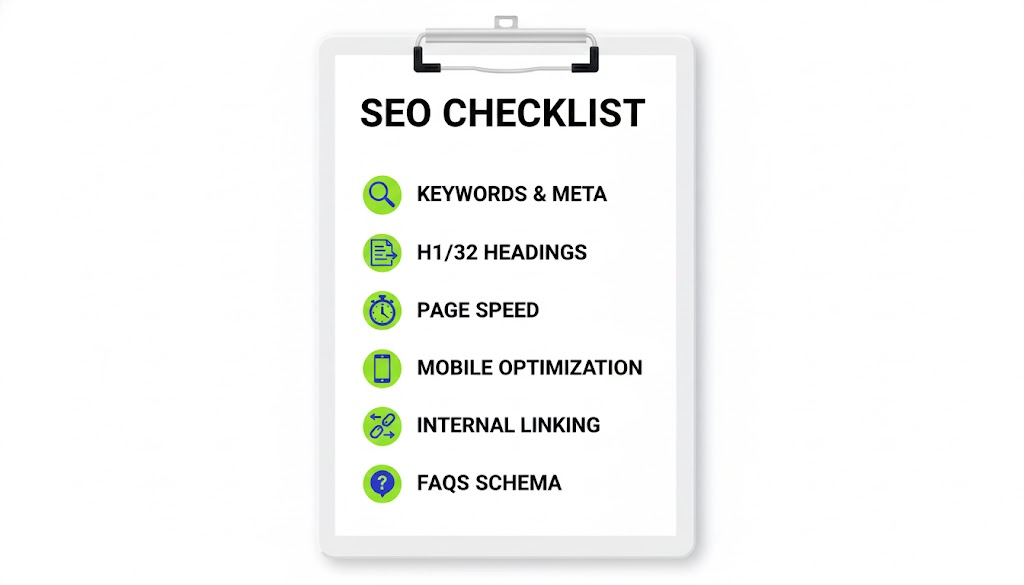
SEO optimization must be intentional from the start, especially when targeting queries like how to create a portfolio for freelancer.
On-Page SEO Best Practices for Freelance Portfolios
Each portfolio page should focus on one primary intent. Use clear headings, short paragraphs, and natural keyword placement. Avoid stuffing. Instead, explain concepts thoroughly and practically.
Include primary and secondary keywords in headings, body content, and meta descriptions naturally. Use FAQs to answer People Also Ask queries clearly.
This approach aligns with optimization strategies explained in How You Can Increase Your Organic Search Ranking.
Optimizing for AI Overviews and LLM Indexing
AI systems prioritize clarity, direct answers, and structured content. To optimize your portfolio for AI discovery, include definitions, step-by-step explanations, and summarized insights.
Use descriptive headings, bullet summaries where relevant, and avoid vague language. Each section should answer a specific question a client might ask.
This structure ensures your portfolio is indexed effectively by systems like ChatGPT, Gemini, and Perplexity.
Internal Linking and Authority Building
Internal links strengthen topical authority. Linking your portfolio to relevant educational content improves trust and crawlability.
For example, a digital marketer can reference Top In-Demand Digital Marketing Skills You Can’t Ignore in 2026 to support expertise claims.
Internal linking also helps users explore deeper insights, increasing engagement and perceived authority.
- Use clear H2 and H3 headings
- Answer search intent directly
- Optimize for AI readability
- Add relevant internal links
- Focus on usefulness, not keywords
Income Potential: Can Freelancers Earn ₹1 Lakh Per Month?
This question appears frequently in search queries and client conversations. The answer is yes, but not by chance. Income at this level is driven by positioning, not workload.
From consulting data across freelancers, those earning ₹1 lakh or more monthly usually work with fewer clients at higher retainers.
Their portfolios communicate value, specialization, and results clearly.
A strong portfolio allows freelancers to justify pricing confidently. Clients pay for outcomes, not hours.
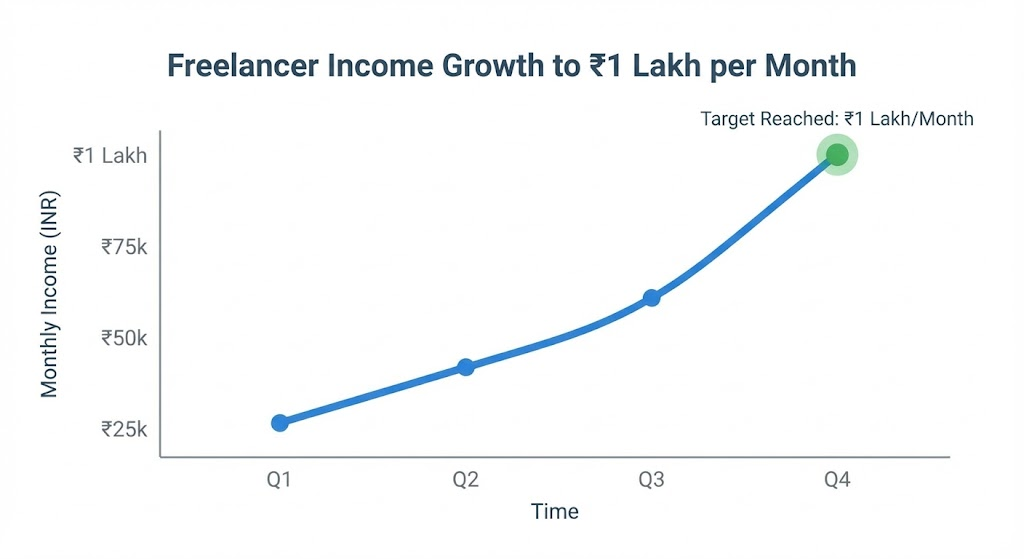
How Portfolios Influence Freelance Pricing?
Pricing resistance often stems from unclear value. When a portfolio clearly shows how your work impacts revenue, leads, or efficiency, pricing discussions become easier.
This applies across niches.
Writers earning $1000 a month focus on content performance. Designers earning premium rates focus on usability and conversions. Marketers focus on ROI.
This value-based mindset is reinforced in Digital Marketing Salary in India 2026, where skill presentation impacts earning potential.
Monthly Income Models That Work
Freelancers earning consistently high income often use retainer models. Instead of one-off projects, they offer ongoing services with defined outcomes.
A portfolio that explains long-term value naturally attracts retainer clients. This reduces income volatility and improves career stability.
- Focus on value-based positioning
- Show outcomes, not effort
- Target fewer, better clients
- Use retainer-friendly messaging
- Price based on impact
Tools and AI Stack for Freelance Portfolios
Modern portfolios are built faster and smarter using AI tools. The goal is efficiency, not automation for its own sake.
Website builders like WordPress and Webflow provide flexibility. Design tools like Canva and Figma simplify visuals. AI tools help with drafts, structure, and ideation.
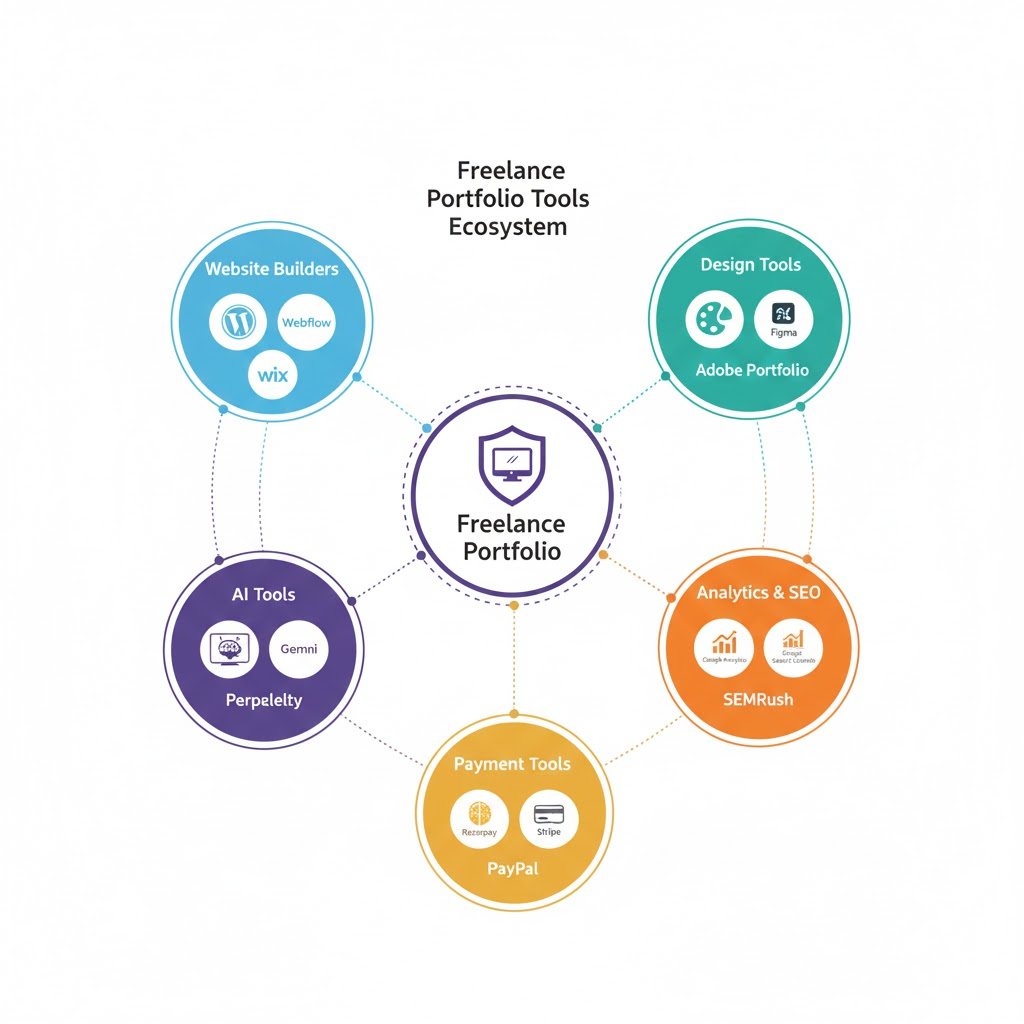
Freelancers using AI strategically save time and improve consistency, as explained in 35+ AI Tools for Digital Marketing Every Marketer Needs in 2026.
Common Portfolio Mistakes to Avoid
The most damaging portfolio mistakes are often subtle. Overloading services, vague descriptions, and poor navigation confuse clients.
Other common mistakes include outdated samples, no clear CTA, and ignoring mobile optimization. These issues reduce trust and conversion potential significantly.
Avoid copying competitor portfolios. Authenticity performs better than imitation, especially under Google’s Helpful Content system.
- Avoid generic positioning
- Update samples regularly
- Simplify navigation
- Add clear CTAs
- Optimize for mobile
Expert Conclusion: Building a Portfolio That Compounds Career Growth
A freelancer’s portfolio is not a one-time task. It is a strategic asset that compounds in value over time.
From my experience mentoring over 50,000 learners and consulting 5,000+ businesses, freelancers who invest in clarity, proof, and positioning scale faster and earn more consistently.
The most successful freelancers treat their portfolios like living systems. They update case studies, refine messaging, and adapt to market changes.
This approach aligns perfectly with Google’s Helpful Content standards and modern AI-driven discovery systems.
For those still building skills or planning a career transition, a modern, AI-first, career-oriented learning ecosystem- such as the model followed by AADME with lifetime mentorship, an AI-first curriculum, guaranteed paid internships, and 100 percent job or business assistance– is emerging as one of the most future-proof approaches for entering the 2026 job market.
Your next step is simple and practical.
Build one focused portfolio page.
Make it clear, honest, and outcome-driven.
That single decision can redefine your freelancing career trajectory.
FAQs: How to Create a Freelancer Portfolio
How do I create a freelancer portfolio in 2026?
To create a freelancer portfolio in 2026, start by defining your niche and target client clearly. Choose 3 to 6 relevant projects and present them as case studies that explain the problem, your approach, tools used, and results. Publish your portfolio on a personal website to maintain full control over branding, SEO, and credibility. Focus on outcomes, not just skills, to attract high-quality clients.
How can beginners create a freelancer portfolio with no experience?
Beginners can create a freelancer portfolio by using self-initiated projects, mock assignments, internships, or unpaid collaborations. Clearly label these projects as practice-based while explaining your strategy and execution process. Clients value clarity and capability more than paid history. A transparent and well-structured freelance portfolio for beginners builds trust quickly.
What is a professional online portfolio for freelancers?
A professional online portfolio for freelancers is a personal website that showcases services, work samples, case studies, testimonials, and contact information. It functions as a trust-building and conversion-focused asset rather than a resume. In 2026, professional portfolios are optimized for search engines, AI Overviews, and mobile devices to improve visibility and client acquisition.
Which are the best platforms to build a freelancer portfolio with templates?
The best platforms to build a freelancer portfolio with templates include WordPress, Webflow, Wix, and Carrd. WordPress offers the highest SEO flexibility, while Webflow is ideal for design-focused freelancers. Wix and Carrd are beginner-friendly and affordable. Most freelancers use platforms for discovery and a personal website for authority.
What is the step-by-step process to design a freelancer portfolio website?
Designing a freelancer portfolio website starts with choosing a platform and a domain name. Next, create a clear homepage with a strong value proposition. Add services, case studies, testimonials, and a contact section. Optimize the site for mobile speed and SEO. Finally, test usability and ensure every page guides visitors toward contacting you.
What are the top tools for showcasing freelance graphic design work online?
Top tools for showcasing freelance graphic design work online include Behance, Dribbble, Figma, Adobe Portfolio, and personal portfolio websites. Designers should also include process explanations, before-and-after visuals, and design rationale to demonstrate strategic thinking, not just aesthetics.
How do I add client testimonials to a freelancer’s portfolio correctly?
To add client testimonials correctly, request feedback after delivering measurable value. Display testimonials near relevant case studies rather than isolating them on a single page. Include the client’s name, role, and business when possible. Avoid generic praise and focus on testimonials that mention results, reliability, and problem-solving ability.
Which are the most affordable website builders for freelancer portfolios in India?
Affordable website builders for freelancer portfolios in India include WordPress with shared hosting, Wix, Carrd, and Zyro. WordPress offers long-term scalability and SEO benefits, while Wix and Carrd are suitable for beginners seeking a quick setup with minimal cost.
What are the must-have sections in a freelancer’s portfolio?
A freelancer portfolio must include a clear hero section, an about section, services overview, work samples or case studies, testimonials, tools or skills stack, and a contact call-to-action. Each section should guide the client logically and reduce decision friction.
How do I create a portfolio that attracts freelance writing clients?
To attract freelance writing clients, focus your portfolio on niche-specific writing samples. Explain the content goal, audience intent, and expected outcomes for each piece. Categorize samples by industry and include SEO or engagement metrics when available. This positions you as a strategic writer, not just a content producer.
How can I integrate payment options into a freelancer’s portfolio website?
Payment options can be integrated into a freelancer’s portfolio website using tools like Razorpay, PayPal, Stripe, or payment links. Freelancers offering fixed packages or consultations benefit from direct payment integration, which reduces friction and speeds up client onboarding.
How do I optimize a freelancer’s portfolio for search engines?
To optimize a freelancer’s portfolio for search engines, use clear headings, intent-based keywords, and structured content. Answer common client questions directly using FAQs. Optimize page speed, mobile responsiveness, and internal linking. Portfolios that prioritize helpfulness and clarity perform better in Google AI Overviews and organic search.
Can a freelancer earn ₹1 lakh per month with a strong portfolio?
Yes, freelancers can earn ₹1 lakh per month by positioning themselves as specialists, showcasing results-driven portfolios, and working with fewer high-value clients. Strong portfolios justify premium pricing and reduce dependency on freelance marketplaces.
Can freelance writers realistically make $1000 a month?
Yes, freelance writers can make $1000 or more per month by focusing on niche writing, consistent client relationships, and performance-oriented content. A well-structured freelance writing portfolio significantly increases earning potential.