

Key Takeaways
- Communicating professionally with clients directly impacts your freelancing success. Sometimes you will face difficult clients who disagree with your views; in that case, you need to answer them calmly without affecting your relationship with them. This approach builds trust and credibility, which opens the door for future opportunities.
- A written contract is essential for the protection of both the freelancer and the client. A written contract acts as a document that outlines the details of projects, including deadlines, revision requests, payment processes, additional fees for extra work, and so on. This minimises disputes and misunderstandings between you and the client.
- Different approaches to be used for different clients. While dealing with a difficult freelance client, your way of connecting with them should be different; you can’t use the same process with all of them. You are dealing with a late-paying client who requests additional work or revisions, so you should respond strategically, not emotionally.
- Asking the right questions before beginning the project leads to better outcomes. Understanding your client’s goals, target audience, budget, expectations, competitors, and deadlines helps to eliminate confusion and conflicts for the future.
Introduction
Have you ever thought that freelancing gives you complete freedom to work according to your own schedule? You can choose the projects, clients, and the opportunity to build your career on your own terms and conditions.
But with the flexibility, you can sometimes face challenges in dealing with some clients.
Whether it’s your initial phase or you have years of experience, you’re going to manage difficult clients who might have high expectations, lack communication, frequently change their minds on any project requirements, or delay the payment process.
That’s the major challenge: how to handle difficult freelance clients. These situations become stressful if not handled with proper strategies and professional planning.
The truth is, difficult clients are unavoidable; you can’t control their behaviour, but you can definitely control the challenging situations by answering them professionally and calmly.
Dealing with client interactions professionally not only helps you complete projects smoothly but also enhances your reputation and builds strong relationships with them, which ultimately leads to long-term growth.
In this blog, you’ll learn strategies on how to handle difficult freelance clients professionally while maintaining healthy relationships with them.
What You’ll Learn in This Blog
In this blog, you’ll learn how to handle a difficult freelance client professionally, maintaining strong and healthy relationships with your clients.
You will learn about different types of difficult freelance clients and how to deal with those types of clients in a calm and professional manner.
Sometimes you will go through challenging situations such as frequent revision requests, late payment processes, lack of communication, etc.
This blog will also help you to set clear expectations, make a written contract, communicate with confidence, and ask some important questions before starting to work on the projects.
You will read about the freelance client management checklist, and also, if there is any confusion, you can refer to the FAQs at the end of the blog, which will give you complete clarity about the blog and also help in your career.
Common Reasons Why Freelancers Face Difficult Clients
The common reasons are included:
- Repeatedly changing the requirements of the projects.
- Lack of communication
- Unachievable deadlines
- Multiple revisions
- Slow payment process
- Non-compliance with agreed terms
- Trust issues
If you recognise these issues at the initial stage, then it becomes easier for you to manage difficult freelancing clients before they become major problems.
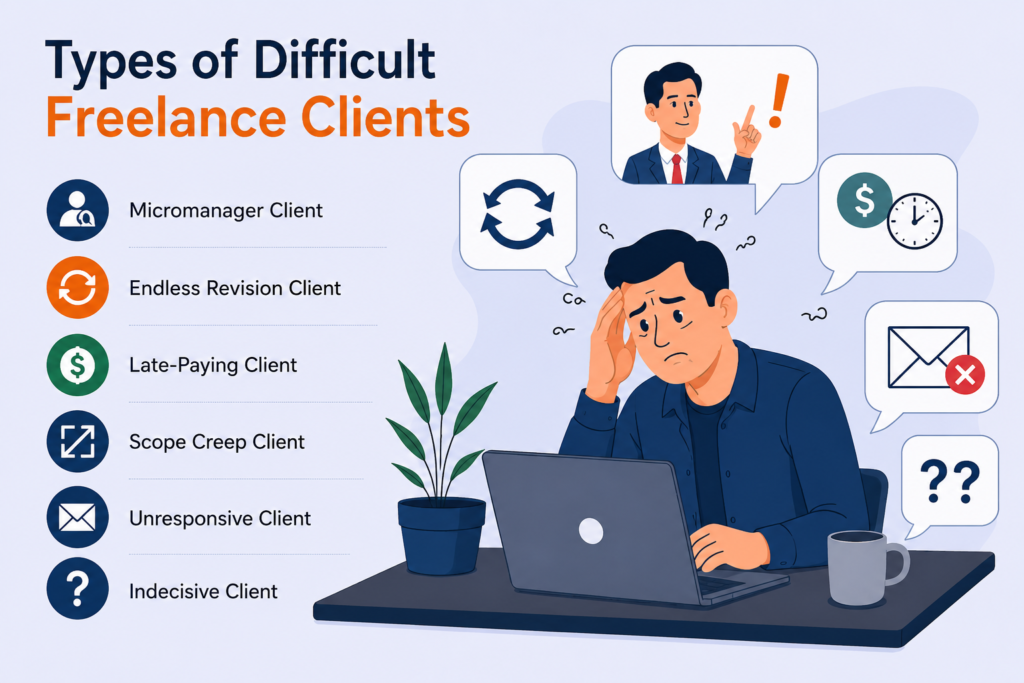
6 Most Challenging Types of Freelance Clients
1. The Micromanager Client
This type of client generally wants minute details of every project. They might ask for your daily progress report, want updates on the projects, and question every decision you make.
But their intention is not to disturb you; the only reason they do it this way is to ensure that the projects meet expectations.
Constantly monitoring can break the momentum of your work. Instead of focusing on freelance projects, your quality time will be wasted responding to their messages and explaining to them.
The best way to manage difficult freelancing clients is to set a clear communication schedule from the beginning. Sharing details of your projects and providing constant updates will build trust and show progress.

2. The Endless Revision Client
This type of client is never satisfied with the final results. Even after doing multiple revisions or reviews, they expect small changes in their projects, due to which they consume hours of unpaid work, leading to delays in other projects as well.
The problem arises when, after multiple revisions, they are still unsatisfied with your work; then it becomes frustrating to manage difficult freelancing clients.
To avoid these types of situations, you need to always mention in your pricing list that additional changes will incur extra charges. Having a clear terms and conditions policy will help you deal with difficult freelancing clients.
3. The Late-Paying Client
This type of client consistently delays or disputes payments. A late-paying client always makes excuses for missing payment deadlines, ignores reminders, and makes fake promises of paying.
This can unnecessarily create financial stress for you, especially when your primary source of income is through freelancing. You need so much patience to deal with difficult freelancing clients.
The best way to handle a difficult freelancing client is to request an advance payment before beginning the project. It should be mentioned in your terms and conditions policy page to avoid confusion with the client.
4. The Scope Creep Client
The scope-creep client demands additional work irrespective of what was agreed upon. They often use phrases like, “Can you make a minute change in this project? These clients generally take a lot of time, increase your workload, and don’t pay extra charges to you.
The major challenge comes in how to handle difficult freelancing clients professionally, and to deal with this, you need to clearly define your project scope in your contract.
Whenever they demand additional work, explain to them politely that this falls outside their contract and extra charges will be incurred for additional work. This strategy will save your precious time without disrupting the relationship with your client.
5. The Unresponsive Client
This type of client is generally seen as absent in important discussions, which leads to delays in approvals, feedback, or additional information, due to which freelancing projects get delayed, and then you are blamed for not completing them within the specified time mentioned in the contract.
To prevent this situation, you need to mention every important clause in your contract. If the client, after repeatedly following up with messages, is inactive, then you should communicate and deliver the message that you are not responsible for all the delays caused to him.
6. The Indecisive Client
An indecisive client frequently changes their mind about the requirements of freelance projects, the design of the projects, or business goals. One day they approve the project, but the next day they demand a different direction.
These constant changes can definitely extend the duration of the project and also increase the workload. These circumstances arise when the client does not have clarity about his project, such as exactly what his requirements are.
To deal with a difficult freelancing client, you need to conduct a session in the beginning and explain to him each and every minute detail of the project before moving to the next phase.
Points to remember while managing difficult freelance clients
1. Set clear boundaries from the beginning
You need to be patient while managing a difficult freelance client because sometimes conflicts may arise due to a lack of communication of important clauses before beginning the project.
As a freelancer, it’s your duty to deliver information regarding the project’s scope, timeline, payment, and deliverables.
Before beginning your work, mention every important point in your contract about the projects in order to avoid conflict and misunderstandings in the future.
2. Communicate your views professionally and transparently
Communicating your views professionally and transparently with a difficult client in freelancing can be a good step towards your goals.
Even in a difficult situation, avoid overreacting and answering aggressively. Instead, try to be calm, respond politely, and provide solutions to their problems.
Keep your clients updated about the project’s progress and inform them immediately if there will be any kind of delay in completing the work.
This helps to maintain a healthy relationship with your client, builds credibility, and
Avoid conflicts. So it’s your responsibility to handle a difficult freelance client professionally and transparently.
3. Use a Written Contract for Every Project
A written contract helps to prevent misunderstandings and conflicts between you and your client.
It clearly outlines the details of the project, payment process, deadlines, revision limits, and ownership of the final work.
In case there is any dispute, you can refer to that contract, which will eventually protect you from further misunderstanding in the future. This helps you to build trust and healthy relationships with your client.
4. Manage conflicts gracefully
Disagreements with clients are inevitable, but with a contract, you can manage them gracefully and professionally. If your client is stressed out or frustrated, then try to avoid arguments, listen to them carefully, and find out a solution for them.
Maintaining a calm and polite tone helps you to build healthy relationships with your clients, which opens the door for future opportunities.
Clients are more likely to cooperate if you listen to them, even if the issue can’t be resolved immediately; then also, they will appreciate your professionalism.
5. Accept late payments professionally
Getting late payments can cause stress to you, especially when you are a new freelancer, and your source of income is only freelancing.
The only solution is to follow a professional payment process. You can send invoices that include payment deadlines and send a reminder message of due payment to them.
If the delay continues, then pause their work until payment is received, as mentioned in your contract. So this is how you can handle a difficult freelancing client professionally.
6. Decline requests professionally whenever needed
It is not necessary to accept every client request. You should say no to them whenever you think it is required. Sometimes a situation may arise where you and your client disagree to a point, and then you should have the courage to decline them.
Many freelancers have the fear of losing clients, especially when you are a fresher freelancer and you agree to their unrealistic deadlines, unpaid work, or excessive workload.
Constantly saying yes to them can reduce the work quality and can lead to burnout, and somehow it becomes difficult to manage freelancing clients. Denying their request respectfully shows your confidence and saves your precious time.
7. Be prepared to terminate the toxic client relationship.
Despite giving your best, if the client continuously disrespects your boundaries or creates a toxic environment, then you should end that relationship.
Before doing that, you should complete their work and communicate your decision professionally.
Losing that toxic client is far better than being in that environment, which is stressing you badly.
Relevant questions to ask every client before starting a freelance project
Your work often depends on the quality of relevant questions you ask your client. Many freelancers rush into freelance projects without gathering the complete information, which could lead to misunderstandings and conflict in the near future.
The questions to be asked from your client are as follows:
- What is the primary objective of this project?
- Brief about your target audience?
- What problems are you dealing with?
- What solutions have you tried to solve your problem?
- What is your expected deadline?
- Who will provide feedback and approvals?
- Who are your competitors?
- What is your budget for this project?
- What is your preferred payment method?
- How many rounds of revision do you expect?
- Do you have existing brand guidelines, logos or content?
- What is your preferred channel of communication?
These types of questions will help you to know about your clients’ tastes and preferences in managing difficult freelancing clients.
Including all important clauses in your contract is necessary to avoid any conflict. Make sure that your client reviews and understands every clause of the contract, and he should agree to the terms and conditions stated in the contract.
Successful freelancers often follow a structured checklist instead of relying on their memory for everything. This checklist helps freelancers to get rid of their mistakes and manage their projects smoothly.
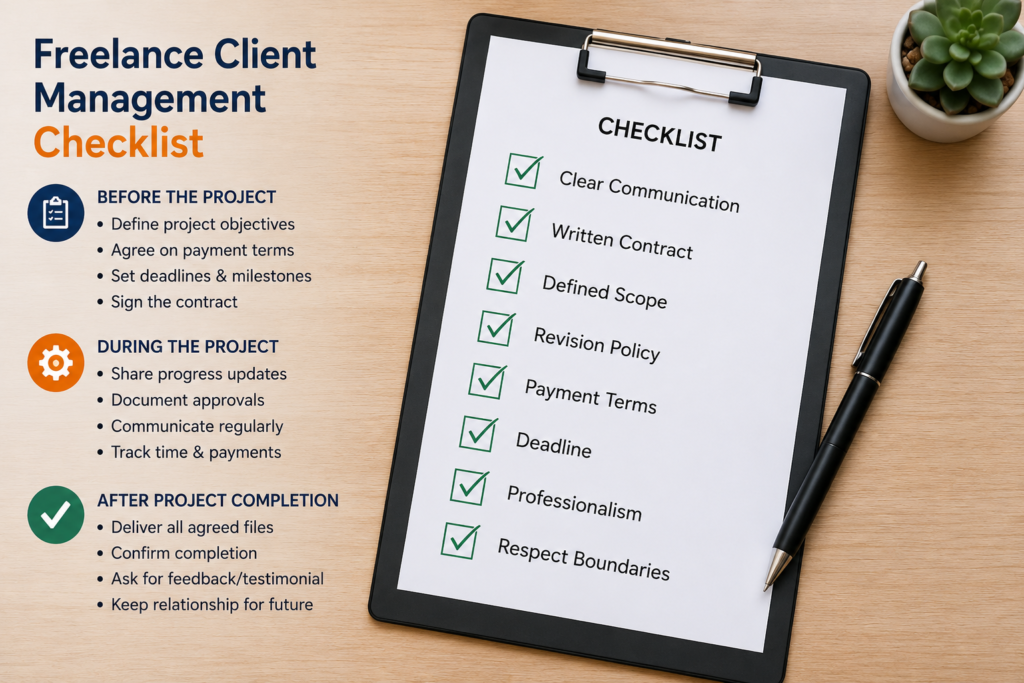
Before beginning the project, you must keep in mind the following points:
- Clearly define your project objectives.
- The client should agree upon payment terms.
- Deadlines of the projects
- Preferred communication channel
- Revision policy
- Required files and resources
- Final contract to be signed
During the project:
- Share progress reports on a daily basis.
- Write down important approvals in writing.
- Confirm new requests before starting additional work.
- Keep invoices and payment records organised.
- Inform clients immediately if there is any change in the timeline.
After project completion:
- Deliver all agreed files.
- Confirm the successful project completion.
- Ask for client feedback or a testimonial.
- Maintain professional communication for future opportunities.
How to handle last-minute difficult client requests
Last-minute client requests are common in freelancing, especially when clients want urgent changes before a deadline.
It’s important to be flexible, but accepting every request without evaluating it might affect your project, leading to missed deadlines, low-quality work, and anxiety.
When a client approaches you with a last-minute request, firstly evaluate whether this falls within the original freelance project scope or not. If it’s a minor change, then you can choose to help them.
You should clearly explain to your client how the additional request may affect your project schedule and deadline, which will be revised if necessary. If the work is urgent, then additional fees are to be charged to the client.
One thing you should keep in mind is that you should never compromise the quality of work to meet the deadlines. Clients appreciate honesty, so you should be honest with your work.
The Psychology behind managing difficult freelance clients
Not every difficult freelance client creates problems. In some cases, their behaviour is influenced by business pressure, past experiences, and unrealistic expectations.
So understanding the psychology behind difficult clients helps you to respond politely and professionally.
Not every difficult freelance client creates problems. In some cases, their behaviour is influenced by business pressure, past experiences, and unrealistic expectations.
So understanding the psychology behind difficult clients helps you to respond politely and professionally.
There are some clients who expect immediate responses or last-minute requests because they are not familiar with the freelancing workflow.
By recognising the factors, freelancers should avoid reacting emotionally and instead focus on providing solutions to them. This helps you to communicate more effectively, establish healthy boundaries, and build stronger relationships with confidence.
Final thoughts
There may be a time when every freelancer has to manage a difficult freelancing client.
It completely depends on you how to handle a difficult freelancing client with confidence, communicate politely, and respond to their questions calmly during disagreements.
Stating each important clause in your contract acts as a protective shield for you when it comes to misunderstandings, unnecessary conflicts, or affecting your relationship with your client.
With time, these simple habits can protect you in resolving disputes and investing more time in growing your freelancing career.
The mantra to handle a difficult freelancing client isn’t to avoid challenging situations but to face them by responding professionally to build trust and make a strong and healthy relationship with them.
But you need to establish a boundary between yourself and your client, and that boundary will be a contract that will protect you from any chaos.
One thing you should remember is that the best freelance relationships depend on mutual respect, clear communication, and trust. t. Your focus should be on giving the best to your client, and if it turns out to be toxic, then you should end that relationship.
Frequently Asked Questions (FAQs)
1. How to deal with difficult freelance clients?
The best way of managing difficult freelance clients is by staying calm and professional, communicating your views properly, and setting expectations from the beginning.
Outlining important clauses in your contract can prevent many misunderstandings and conflicts with your client. In case any problem arises, your focus should be on providing the solution to it instead of reacting.
2. How to decline your client’s request for additional work?
You can decline a client’s request respectfully without affecting the relationship by explaining your reasons.
For example, if a client requests additional work outside your contract, tell them that you are ready to help, but the request requires an updated timeline, and explain the additional charges for extra work.
This approach maintains a healthy relationship with your client, allowing you to share your perspective without any conflict.
3. How to handle a difficult freelance client who pays late?
If a client misses a payment deadline, send a professional and polite reminder and gently remind him about the payment terms and conditions stated in your contract.
You should continue to follow up and avoid starting new freelance projects until the previous dues are cleared, and for future projects, try to take an advance payment to reduce financial risk.
4. Is it normal to have disagreements with freelance clients?
Yes, occasional disagreements with your clients are completely normal. More expectations, lack of communication, or project challenges can often lead to disputes.
To deal with a difficult freelancing client, you should address them calmly, communicate your perspective openly, and work towards practical solutions rather than reacting emotionally.
5. How many revisions should be included in a freelance project?
The number of revisions depends on the type of service you are providing, but many freelancers include two or three rounds of revision.
Make sure to include all the important clauses in your contract to avoid conflict or misunderstanding in the future.
6. Is there a possibility of converting difficult clients into long-term clients?
Yes, but only in some cases can you deal with difficult freelancing clients.
Misunderstandings can be resolved through honest and polite conversations and better project management.
However, if a client consistently disrespects you and your work, refuses to pay, or exceeds the boundaries, then it’s better to terminate that relationship and invest your time and energy in other clients who appreciate your work.
7. When to end a relationship with a difficult freelance client?
You can end your relationship with a client when he refuses to pay, ignores terms and conditions, requests additional work without extra pay, disrespects you because of continuing projects, or creates an unhealthy or toxic environment.
Working with such clients causes mental stress and anxiety for freelancers, so if you notice any of these signs, then it’s better for you to end that relationship for your peace of mind.