Key takeaways:
- Focus on the right audience, not numbers – getting a large number of leads doesn’t guarantee conversions. If you focus on attracting the right audience, then your conversion rate will increase, and it will help you to turn website visitors into leads.
- Build landing pages with one clear conversion goal – your landing page should guide visitors to take the next step instead of simply providing information. It should include relevant information, CTAs, offers, and headlines that match the visitors’ search intent.
- Include CTAs to guide the visitors on what to do next – your CTA should be action-orientated instead of generic. You can use the request a demo, get your free quote, book a free strategy call, or get a free website audit to turn website visitors into leads.
- Keep lead generation forms simple – always try to keep the lead form simple. If it’s too complicated, then the visitors might bounce back without taking further action. Your goal should be to make the form submission easy without affecting the lead quality.
Introduction
Are you getting thousands of visitors every month to your website but still facing challenges in converting them into leads?
This is the most common problem businesses are dealing with today. You spend money on paid advertising, social media, SEO, content marketing, and other channels to drive traffic and turn website visitors into leads.
But the real challenge comes when visitors come and bounce back without taking any action on your website.
A visitor can browse your services, read blogs, check pricing and offers, and bounce back without filling out the form, requesting a demo, booking a free consultation call, or even without buying anything.
This is the situation where your website visitors are not converting into leads.
Conversion rate optimisation (CRO) helps improve the website experience and guides visitors to take valuable action such as making a purchase, booking a demo, or converting into leads.
Always remember your goal should be to attract the right visitor and increase conversions. Conversion doesn’t mean getting more visitors to fill out a form. You should focus on the quality of leads instead of numbers.
If your website is well optimised, then it not only turn website visitors into leads but also guides them on what action they should take next in their buying journey.
What you’ll learn in this blog-
In this blog, you will understand the difference between visitors, leads and customers, along with 8 effective strategies to turn website visitors into leads, and below you will also go through some of the challenges businesses face in converting visitors into leads.
At last you will read how you can improve website lead generation without focusing on the lead numbers, and if any doubt is left, then you can refer FAQs through which you will get clarity about each and everything.
Let’s understand the difference between visitors, leads, and customers.
Before you optimise your website, understanding the difference between them is really important, and it provides clarity and information to visitors.
These are the different stages of a buying journey that help you to create valuable content, calls to action, and offers and help with website lead generation.
Website Visitors
Website visitors are those people who land on your website through paid ads, search engines, social media, email campaigns, referrals, and other sources.
This is the stage where visitors come and explore your services, gathering information, evaluating your business, and researching a problem. Though he is not your potential customer, you need to encourage him to take the next step.
Leads
A visitor converts into a lead when he shows some interest in your product and services and is ready to share personal details with you for the business.
Not every lead is going to convert. Some may only research, while some genuinely need your product or services. So you should always focus on attracting qualified leads by targeting the right audience that is relevant for your business.
Customers
Customers are leads who have taken the final action, i.e., made the decision to buy your product or services. This is the final stage where your marketing and sales efforts translate into business revenue.
Your goal for the website should be to help the right people through their buyer journey and not to collect personal details and generate traffic.
The overall journey can be understood as:
Website Visitor → Lead → Qualified Lead → Customer
Your website should help people to move in the right direction, i.e., from stage one to the last stage.

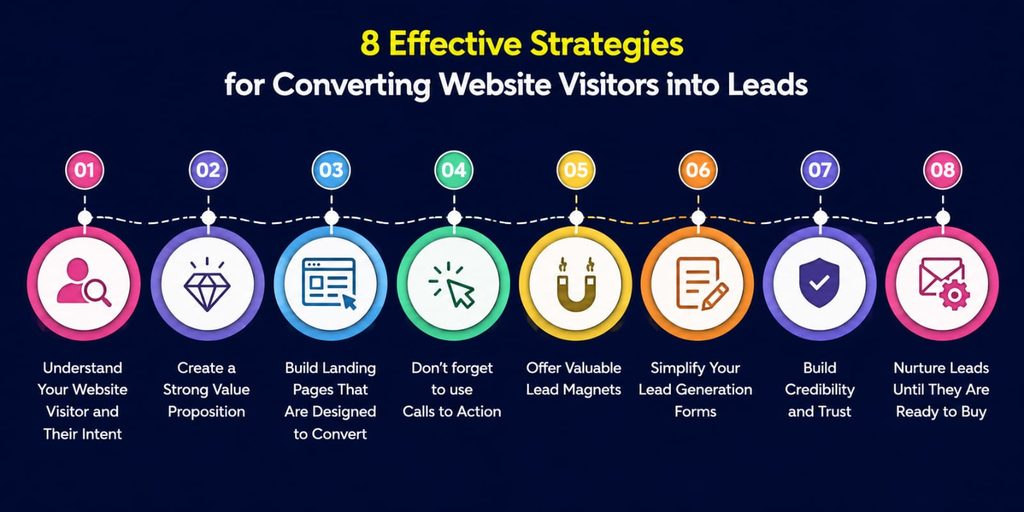
8 effective strategies for converting website visitors into leads
1. Understand Your Website Visitor and Their Intent
Before you turn website visitors into leads, the first thing you need to understand is who your visitor is, what they are looking for, and at what stage they are on their buyer journey.
Because every visitor lands on your website with a different purpose. Some may look to gather information about your products or services, while some may compare your solutions with others, and some are ready to take the next step with you.
Understanding your visitors’ intent will help you to generate the right content, landing pages, offers, calls to action, and buying behaviour. Avoid showing the same message to every visitor; this makes it difficult for you to convert website visitors into leads.
Analyse where your maximum visitors are coming from and the activity they do after landing on your website. This information helps you to identify where your audience has shown interest and where you’re losing potential clients.
2. Create a Strong Value Proposition
After understanding your visitors, the next step is to communicate why they should choose your products or services.
Your value proposition should provide information-
- What are you offering?
- whom you help
- What benefits they will receive
You should keep your message clear and focus on customer benefits. Using a strong headline can help you to turn website visitors into leads.
To build trust and credibility, always use case studies, testimonials, and business insights. A strong value proposition gives visitors a reason to continue to explore the website and increases the chances of conversion.
3. Build Landing Pages That Are Designed to Convert
Your landing page should provide information, as well as be created with a conversion goal for your business.
When website visitors arrive and are searching for what they want, and if your website directly matches their search intent, then there is a chance that they are likely to take action.
Your landing page should have relevant headlines, offers, information, and a call to action. Avoid unnecessary links and elements that confuse visitors.
Your page should be easy to navigate, work properly, and load quickly on mobile devices. Make sure that your landing page matches the visitors’ expectations, whether it is from social media, advertisements, email, or a search result.
4. Don’t forget to use calls to action
If your website lacks a call to action button, then the interested visitors might bounce back without taking any action. A clear call to action gives direction to website visitors and guides them on what step they should take next towards the stages of the buyer’s journey.
Avoid using generic phrases like –
- Learn more
- Click here
- Submit
You can use different calls to action for different stages of the buyer’s journey. Testing different CTA wording, presentation, and placement will help you understand what encourages them to take action and turn website visitors into leads.
5. Offer Valuable Lead Magnets
Not every visitor is ready to buy your products or services on their first visit. Some might be interested but want more information before taking any action.
A valuable lead magnet gives visitors a reason to engage with you and share their personal details. A lead magnet should solve the audience’s problem by proving a solution that satisfies them. It could be an ebook, consultations, a free audit, or a case study.
You should focus on creating something valuable that attracts and turns website visitors into leads. Your offer should be related to your product or service so that people who download it are relevant for your business.
6. Simplify Your Lead Generation Forms
A lead form acts as a conversation process because, after this process, a website visitor officially becomes your lead.
If your lead generation form is complex or unnecessarily long, it can create friction, and visitors bounce back without submitting their personal details.
Always collect the visitors’ personal details that are relevant for your business. Your form should consist of clear labels, and it should work properly on mobile devices. Your purpose should be to reduce friction while affecting the lead quality.
7. Build credibility and trust
Visitors will convert into leads only when they trust your business. You can use case studies, testimonials, feedback, results, reviews, awards and certifications, and other relevant trust signals.
Visitors will trust you when you genuinely understand their problem and provide a solution to them; only then will you be able to attract website visitors into leads.
But you should always avoid using exaggerated claims or fake testimonials to increase conversions. Your website should give enough evidence so that visitors may trust you and feel confident about taking any action.
8. Nurture Leads Until They Are Ready to Buy
It is not necessary for every visitor to convert into a lead. This is where the role of lead nurturing comes in. It allows you to stay connected with your prospects by providing relevant information throughout their buyer’s journey.
You can use educational content, email marketing, webinars, follow-ups, case studies, and retargeting campaigns to keep your business relevant.
You can address the common questions, share useful business insights, and gradually introduce your product or service as a solution. If you consistently nurture leads, it will help interested website visitors get closer to a purchasing decision.
Challenges businesses face in converting website visitors into leads
Getting a good amount of traffic, but if you are still struggling with website lead generation, there may be several reasons for it.
A weak call to action, complicated navigation, a poorly designed landing page, and a slow-loading page also make visitors leave without taking the next step. If you understand the challenges, then it not only attracts visitors but also encourages them to take further action.
Below are some of the challenges that businesses face:
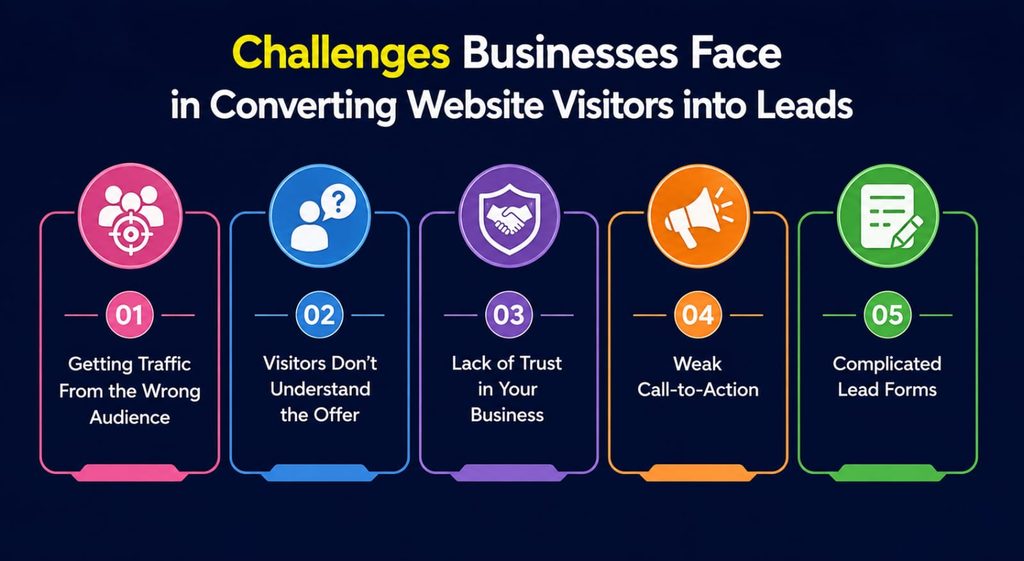
1- Getting Traffic From the Wrong Audience
The major challenge businesses face is targeting the wrong audience, i.e., people who are not interested in buying your products or services. A large amount of traffic looks impressive, but it will not turn website visitors into leads.
This usually happens when you target broad keywords, run paid ads without understanding the audience, or use unclear messages. So, very few visitors will convert into quality leads.
Firstly, before targeting, always identify an ideal client profile and segment them; after that, focus on relevant keywords, content topics, and campaigns.
Challenge 2: Visitors Don’t Understand the Offer
If you use complicated language, vague statements, or industry-specific terms, it might confuse visitors, and they will not be able to understand your offer within a few seconds; then there is a chance visitors will leave your website without taking the next step.
Your website should immediately answer visitors.
- What are you offering?
- Who is it for?
- What result can customers expect from you?
Your website should clearly communicate the value to your website visitors.
Challenge 3: Lack of Trust in Your Business
To build trust and credibility among visitors, you should use case studies, testimonials, reviews, feedback, awards and certifications, and business insights as evidence because real evidence is more convincing than simply claiming about your business.
Your goal should be to build trust before sales conversion because a new visitor might compare several companies before making the final decision, especially when it involves a significant investment.
If you follow this method, then it becomes easier for you to turn website visitors into leads and build trust and reliability.
Challenge 4: Weak Call-to-Action
If visitors are interested in your product or services and the call to action is missing, then they may leave without taking the next step. A call to action gives visitors clear direction for the specific step they should take next.
You should use action-orientated CTAs, like ‘Book a free consultation call’, ‘Download the free guide’, and ‘Start your free trial’, instead of using generic CTAs.
CTA should be placed where it is easily visible to website visitors. You can place it after the key information that helps them make a decision.
Challenge 5: Complicated Lead Forms
If your form is complex and visitors are not able to understand it, then there are chances your business might lose potential leads.
You should always keep the lead form simple and ask only for those personal details that are relevant for your business, such as name, contact no., email address, or one qualifying question.
Using this approach doesn’t irritate visitors and increases the tendency of website lead generation. Your goal should be to make them submit the form quickly, easily, and without wasting their time.
Conclusion
Getting more website traffic doesn’t mean that it will convert into leads or sales. Your goal should be to make the website a part of marketing and sales by guiding the visitors to take action.
Your purpose should be to attract the right audience and turn website visitors into leads who have shown interest in buying your products or services.
Regularly analyse your website performance, identify why website visitors leave without taking action, test elements relevant to your business, and improve conversions without affecting lead quality.
Always try to understand your visitor intent, optimise your website, and check whether it consists of CTAs, simple lead forms, testimonials and case studies, and relevant information, and offer lead magnets to turn website visitors into leads.
Frequently Asked Questions
1. What are the important reasons for not converting visitors into leads?
The major reasons are unclear messaging, weak call to action, poor website navigation, complicated lead forms, irrelevant traffic, slow loading speed, and lack of trust and credibility.
So, you need to identify why visitors are going back without taking any action and try to improve the part of the user journey to turn website visitors into leads.
2. How to increase website lead generation?
The first step you should focus on is to create an ideal client profile (ICP), and on the basis of that, understand their intent, use a strong call to action, create a clear landing page, create simple lead forms, add testimonials and case studies for evidence, and offer lead magnets.
If you follow this approach, then it becomes easier for you to convert website visitors into leads and increase business growth.
3. What should be included in a lead generation form?
You should ask your website visitors only for the information that is relevant for your business so that it becomes easy for them to take the next step.
So, the information should consist of a name, contact number, email address, company name, and one qualifying question. Avoid using complicated lead forms, but if necessary, then you should use them when the additional information genuinely helps in generating leads.
4. Which CTA is best for converting website visitors into leads?
The CTA should be clear, action-orientated, relevant, and communicate a specific benefit. Avoid using a generic CTA; instead, you can use-
- Download the free guide.
- Book a free strategy call
- Request a demo.
- Get your free quote.
- Get a free website audit.
A good call to action helps visitors with website lead generation.
5. Does the lead magnet help to generate leads from the website?
It is not necessary for it to help you generate leads, but yes, lead magnets can be useful when visitors are not ready to buy your products or services immediately; they are not suitable for every business.
A lead magnet generally works when you offer something valuable to your website visitors, and in exchange you get the personal details of your visitors. It can be an ebook, free guide, checklist, webinar, free consultation, or case study.
6. What is a good conversion rate for a website?
There is no fixed conversion rate that works for every business. It totally depends on the following factors:
- Traffic source
- Pricing
- Buying journey
- Offer
- Industry
- Target audience
You should track the current conversion rate and focus on improving it without compromising lead quality to turn website visitors into leads.