
Key Takeaways
- A strong B2B email strategy focuses on quality rather than quantity – sending emails in bulk to a large number of people without identifying the target audience doesn’t guarantee leads. Business should focus on reaching the right prospects for B2B lead generation.
- Lead nurturing helps to convert prospects over time – every prospect will not buy your product or services immediately, so businesses can use educational content, follow-up emails, product updates, and case studies to build credibility and healthy relationships.
- Use different types of emails at different stages of the buyer’s journey – you can use cold emails, follow-up emails, product or service emails, promotional emails, lead nurturing emails and case study emails to attract, nurture, educate and convert prospects for B2B lead generation.
- Strong call to action and subject lines can increase engagement – never skip the call to action because it guides the prospect to take the next step, and a relevant subject line encourages the prospect to open and read the email.
Introduction
The biggest challenge businesses face today is generating leads. Finding the right target audience, finding pain points, providing solutions, building credibility, and converting visitors into customers with a well-planned strategy.
Businesses use several platforms or channels to reach a larger audience through social media, paid advertising, email marketing, SEO, networking, and cold calling for B2B lead generation.
Email marketing is the most effective way to reach more people, and the conversion rate is also high. So, you can communicate directly with potential customers without depending entirely on expensive paid campaigns and social media.
Well-planned email marketing for B2B can educate your customers about your products and services, introduce them to your business or brand, build healthy relationships with your customers, and encourage visitors to take action.
One thing you should know is that simply sending promotional emails doesn’t guarantee you B2B lead generation because many businesses make the mistake of focusing on the number of emails instead of quality and relevant messaging.
It requires the right target audience, personalised follow-ups consistently, relevant messaging, and a clear call to action. When you use email marketing correctly, it can become more than a communication channel. It also works as a lead-nurturing system for B2B email leads.
What you’ll learn in this blog-
In this blog you’ll learn what B2B lead generation is and how it works. Next you’ll understand the concept of B2B email marketing and how businesses can use it. What are the steps to build an effective B2B email lead generation strategy?
Further, you’ll learn how to create strong subject lines and valuable email messages. What are the different types of emails that help in generating B2B email leads? And also, at last, if any doubt is left, then with FAQS you will attain the clarity.
Understanding the concept of B2B lead generation?
B2B lead generation simply means identifying and attracting the right audience for your business who might be interested in your products or services.
B2B involves multiple people, like a business owner, a marketing head, an individual, a decision maker, a manager, and a procurement team. Your goal should be to attract the right prospect and gradually move towards becoming customers.
The email marketing B2B lead generation process starts with identifying the ideal customer profile. Businesses need to understand their target audience, company size, market trends, consumer behaviour and buying patterns, business challenges, goals, and competitors.
Once you know about your target audience, you can start with email marketing and send relevant messages to generate B2B email leads.

What Is B2B Email Marketing?
B2B email marketing means communicating with potential customers, business owners, working professionals, agency owners, freelancers, IT SaaS founders, and decision-makers using emails.
You can use email to:
- Sharing educational content
- Promoting offers
- Introduce your products or services.
- Inviting prospects to webinars or demos
- Nurture potential customers.
- Share customer testimonials and case studies.
- Follow up with prospects.
- Retargeting inactive leads
- Move prospects toward a sales conversation.
How Email Marketing Helps in B2B Lead Generation
Email marketing supports B2B lead generation at multiple stages in a customer journey. You can use email marketing in businesses or companies to nurture potential customers, attract the right prospects, build trust and healthy relationships, and encourage them to take action.
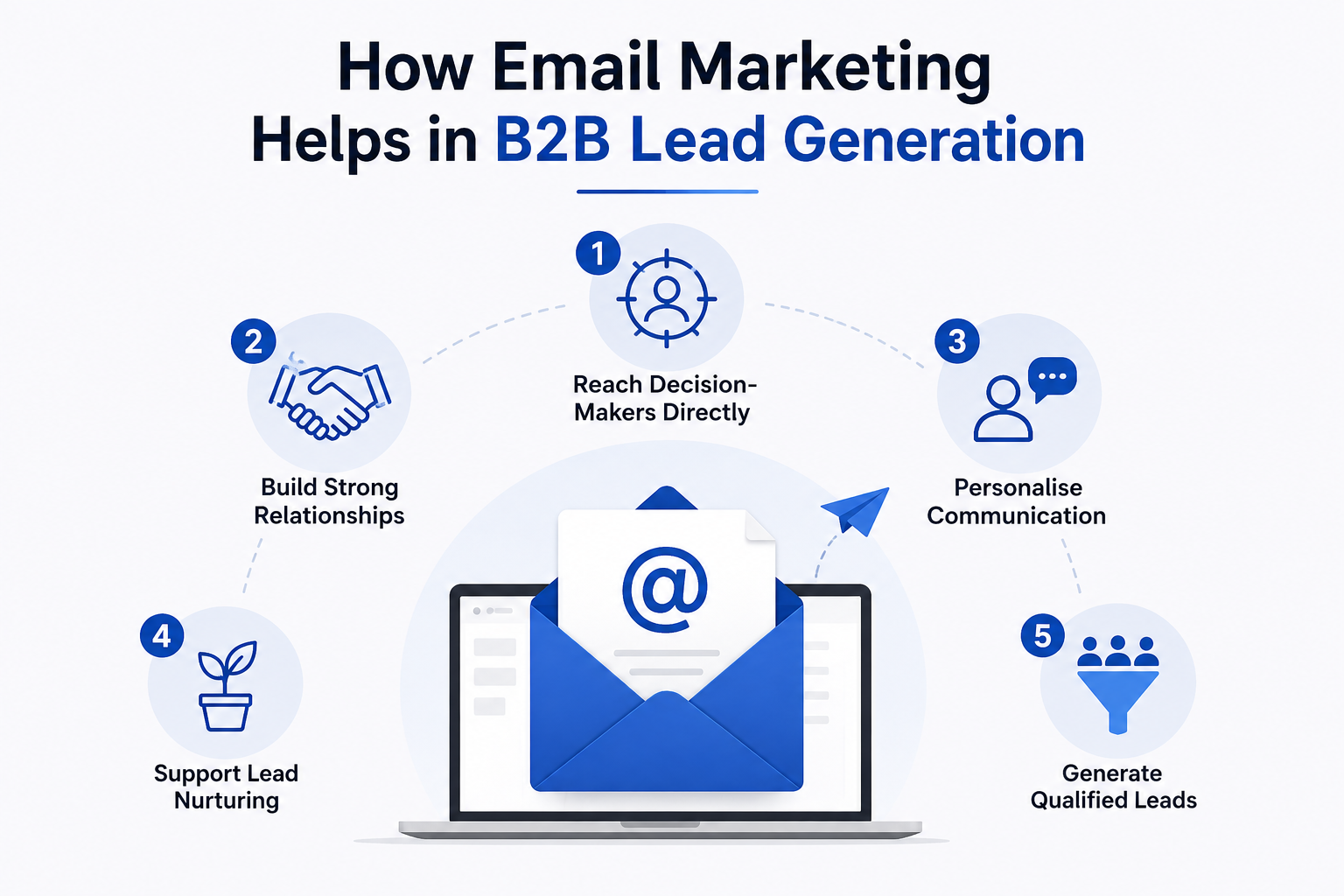
1. It helps directly in reaching decision-makers
The biggest advantage of email marketing with your audience.
You need to reach the specific audience, so instead of waiting for the prospects to discover your business, you can directly communicate with them. The most important thing you should keep in mind is that you can’t send the same message to everyone.
It should be relevant to their role, potential challenges, and business.
2. It helps in building healthy relationships with prospects.
Many prospects will not make the decision to purchase your products or services immediately. They may look at customer reviews and testimonials or book a consultation call before making a purchase.
Instead of sending one sales B2B email lead message, you can create a series of emails that educate the prospect.
For example:
In email 1, you can introduce a problem.
In email 2, you can explain how you’re going to solve the problem.
Email 3: share a relevant case study to build trust.
Email 4 can explain how the company’s service works.
Email 5 can invite the prospect to book a free consultation call or demo.
This complete process is known as lead nurturing.
3. It Allows Businesses to Personalise Communication
Personalisation is an important part of email marketing for B2B because every prospect has different tastes and preferences, challenges, and buying intent.
Instead of sending generic messages to everyone, you should segment them on the basis of age, gender, company size, industry, location, website activity, buying behaviour, and product interests.
Different emails should be sent to different target audiences as per the needs and situation, and this results in an increase in conversion rate, more clicks, and responses.
4. It Supports Lead Nurturing
Not every prospect will buy your products or services immediately, even if your offer is the best, because some prospects may have a genuine requirement, while some do not.
Some may be interested in buying, but if your price is high, then they may think and research more before buying. You cannot ignore these prospects. You can simply nurture them through email to stay connected with them.
You can send industry insights, educational content, product updates and offers, customer success stories, and other useful information through email marketing for B2B. The objective is to provide the right information at the right time.
5. Emails Can Generate Qualified Leads
Getting hundreds of email subscribers doesn’t mean you have quality leads. Your focus should be on lead quality rather than simply increasing the number of contacts.
There may also be some junk leads, like if any person who has no interest in your services or the product is not relevant for their business, then these are counted as junk leads.
That’s the reason why segmentation and targeting are necessary for B2B lead generation.
Steps to Build an Effective B2B Email Lead Generation Strategy
Email marketing requires more than simply sending messages to a large number of prospects.
You need to identify your target audience, understand their pain points, and guide them on how their problems are going to be resolved.
A well-planned strategy helps businesses to build healthy relationships, reach qualified prospects, and convert visitors into customers for B2B lead generation.
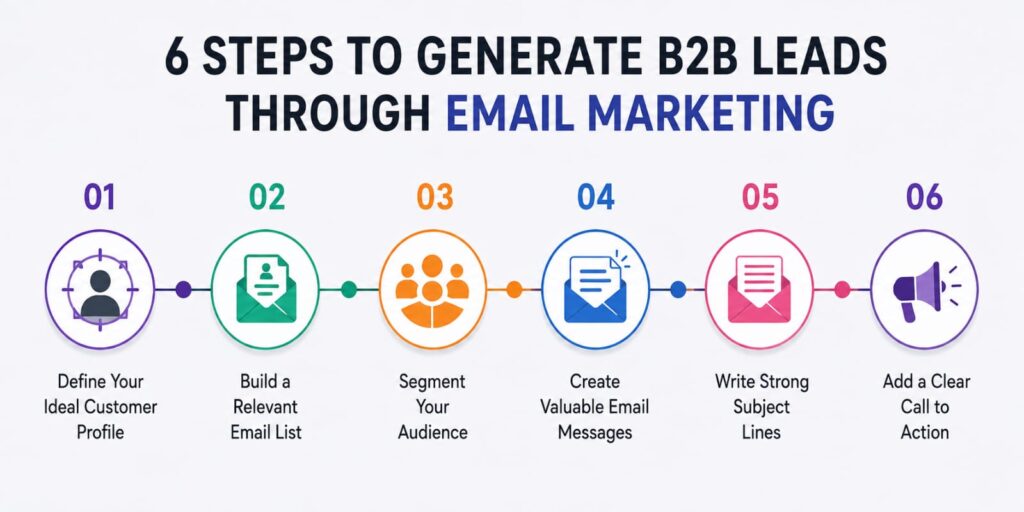
Below are the key steps to build an effective B2B email lead generation strategy:
Step 1: Define Your Ideal Customer Profile
Before sending mail, you should first identify your target audience, i.e., whom you want your mail to reach.
Create an ideal customer profile based on factors such as:
- Location
- Company size
- Buying behaviour
- Industry
- Budget
- Job title
- Business challenges
- Business goals
Step 2: Build a Relevant Email List
A large list of contacts looks impressive, but there are some irrelevant contacts that can affect the engagement and conversion rates. Your email list is the foundation of your email lead generation strategy.
Businesses can build email lists through:
- Webinars
- Industry events
- Lead magnets
- Website forms
- LinkedIn outreach
- Newsletter subscription
- Free consultations
- Product demos
- Existing customer referrals
Step 3: Segmenting Your Audience
Once your email list is ready, properly segment it into smaller groups.
For example, a digital marketing agency could create separate segments for:
- Local businesses
- Existing customers
- Startup founders
- Prospects who requested a consultation
- SaaS companies
- E-commerce businesses
- Marketing managers
Different audiences have different tastes and preferences, so always segment your audience into groups to send relevant messages for email marketing B2B lead generation.
Step 4: Create Valuable Email Messages
Your emails should have a strong hook, and they should provide a reason for the prospects to open and read them. Your email should be educational, promotional, storytelling, and commercial content.
You can share:
- Tutorials
- Checklists
- Mistakes to avoid
- Industry tips
- Case studies
- Offers or discounts
- Customers’ success stories
- Product updates
- Reports
- Research
Step 5: Write Strong Subject Lines
Your subject line decides whether the recipient will open it or not. So you should avoid overly promotional subject lines for B2B lead generation. Try to make it more specific and relevant.
Examples include:
- Whether your website is losing b2b leads
- A simple procedure to increase your sales pipeline
- “5 Ways to Reduce Your Customer Acquisition Cost”
- “How SaaS Companies Can Generate High-Quality Leads”
If your subject line is good, then it will generate curiosity for recipients to open the email and read it.
Step 6: Add a Clear Call to Action
Every email should have a clear call to action. If it’s missing, then your prospect will leave your email without taking any action. So it’s your duty to educate them on what step they should take next in email lead generation.
Depending on the objective, the CTA could be:
- Read the case study.
- Book a demo.
- Visit the website.
- Start a free trial.
- Download the guide.
- Schedule a call.
- Request a quote.
- Start a free trial.
- Reply to this email.
You should always focus on the fact that one email doesn’t have multiple calls to action because it will irritate prospects and will bounce back without buying your services or products.
Types of Emails That Can Generate B2B Leads
As you know, not everybody is ready to purchase your products or services immediately. Some prospects may have heard about your business for the very first time, while others may be comparing different solutions.
That’s the major reason businesses need different types of emails for different target audiences to educate, attract, nurture, and ultimately convert prospects for B2B lead generation. You can use different email formats throughout the customer’s journey.
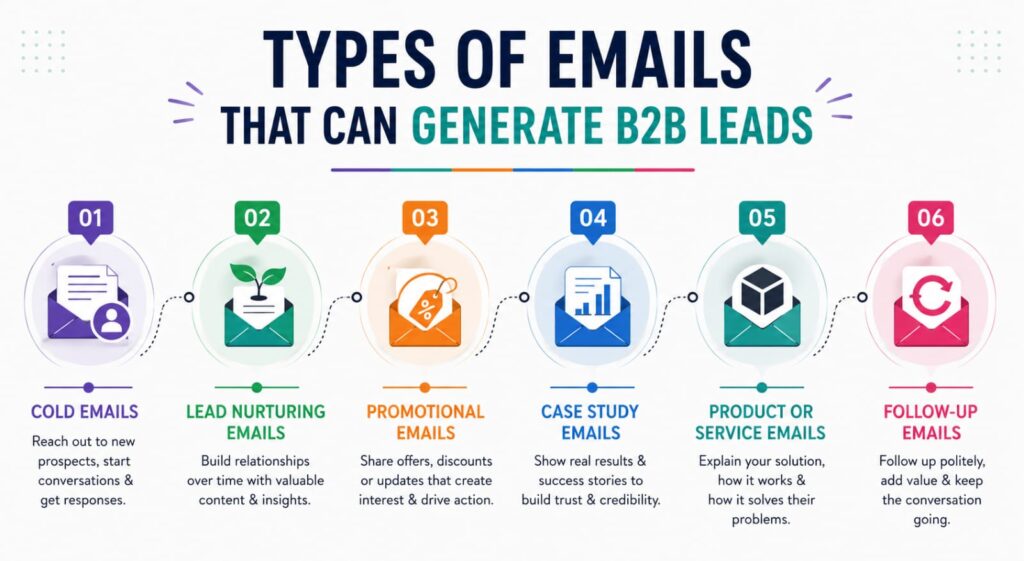
Let’s understand different types of emails that help in generating B2B email leads.
1. Cold Emails
Cold emails are generally sent to those prospects who have not previously interacted with your business, but they are useful for B2B prospecting and can help in reaching the decision-makers directly.
A good cold email should be focused, short, and relevant and should clearly explain-
- What’s the reason for connecting with that person?
- What problem can you solve?
- Why the message is relevant to them
- What is the next step they should take
The purpose behind sending the cold email is not always to take immediate action or convert into a customer but rather to start the conversation or get a response from a qualified prospect.
You should always avoid writing long paragraphs about your business or company; instead, be precise and clear, and this makes your email more relevant for email marketing for B2B.
2. Lead Nurturing Emails
Lead nurturing emails are designed to keep customers engaged over time. These emails are useful when the B2B buying cycle is too long because not every B2B email lead is going to convert.
So, lead nurturing helps to stay connected and build healthy relationships with the prospects. You can use these emails to share valuable content like educational and industry insights, case studies, guides, and other useful resources.
3. Promotional Emails
These types of emails are used to introduce a specific offer, product, service, discount, free consultation, limited-time opportunity, or demo.
B2B businesses should avoid making every email promotional in email marketing lead generation. If the prospect constantly receives sales messages, then they might lose interest and unsubscribe from email.
Promotional emails should always be sent to the prospects when the offer is genuine and is relevant to the prospects’ needs and preferences.
4. Case Study Emails
Case study emails are effective for B2B lead generation because they provide evidence and results. If you share the case study in emails with the prospects, this generally builds credibility and helps in building healthy relationships with your prospects.
It also acts as evidence for other customers, and a strong case study includes the customers’ problems and the solution provided by you and what the desired results are. A case study helps you to show other customers how to overcome a similar challenge.
5. Product or Service Emails
If you identify a customer’s problem and provide a solution that delivers results and positive feedback, your next step should be to educate your prospect, and once they understand the problem and the solution, product-focused emails can explain how your solution has helped customers overcome their problems.
These types of emails explain to your prospects how the solution works and why it is so relevant for them in email marketing B2B lead generation.
6. Follow-Up Emails
Follow-up emails are important because many prospects will ignore and not respond to the first email. It gives you another opportunity to continue the conversation with the prospects without being aggressive for B2B lead generation.
Every follow-up email should provide something valuable, such as insights into the businesses, clients’ testimonials or case studies, answering common questions, and explaining the limited-time offer.
Conclusion
Email marketing is considered to be the most powerful channel for businesses that are looking for B2B lead generation. You can directly communicate with your potential customers, find their pain points, provide solutions, understand them in depth, build credibility, and nurture them.
Sending a large number of promotional emails is not good marketing. The real results are when you identify the right target audience, segment them into groups, and then send relevant messages at the right time.
You can send different types of emails for B2B lead generation, such as educational emails, product or service emails, follow-up emails, lead nurturing emails, promotional emails, and cold emails at the right time.
You should focus on the quality of emails instead of sending them to a large number of people. Tracking metrics like qualified leads, conversions, replies, and meetings booked helps you to understand what is working and where you need improvement for email lead generation.
With a proper, well-planned strategy, if you focus on the needs of your target audience, it will become cost-effective and consistent for generating B2B email leads.
Frequently Asked Questions
1. How does email marketing help in B2B lead generation?
Email marketing helps companies or businesses to communicate directly with potential customers, helps build relationships, nurtures prospects, and helps them move through the buying journey.
You can use educational content, personalised emails, case studies, customer testimonials, offers and discounts, and follow-ups to convert prospects into B2B email leads.
2. What types of emails are effective for B2B lead generation?
Different types of emails support B2B lead generation, such as cold emails, product or service emails, lead nurturing emails, case study emails, follow-up emails, webinar invitations, and educational newsletters.
Before sending emails, you should first identify your target audience and segment them into smaller groups and accordingly send emails to them.
3. Should B2B businesses buy email lists?
Buying random email lists is not a good strategy for email marketing B2B lead generation because purchased lists can be outdated or consist of irrelevant contacts, which may lead to an increase in junk leads.
This generally leads to low conversion, poor engagement, and delivery problems and is counted as spam. Building a relevant email list through legal marketing activities is a better approach.
4. What is the difference between B2B email marketing and cold email?
B2b email marketing is a broader strategy that includes lead nurturing, newsletters, educational emails, product updates, promotional campaigns, and other forms of business-related information.
Cold email is a specific type of email where your prospect has not previously interacted with your business or company. Your email should always be short and clearly communicate your message for B2B lead generation.
5. Does email marketing help in generating international B2B clients?
Yes, email marketing helps businesses reach potential B2B clients globally and supports email lead generation. You can segment prospects on the basis of country, company size, industry, and job role and create relevant campaigns for different markets.
You should also research the target markets, and with the right target audience, constant follow-up, and messaging, email marketing can help businesses generate qualified international B2B clients and build long-term relationships with them.
6. What metrics should I track for B2B email lead generation?
Important metrics that you should track are reply rate, bounce rate, click-through rate, meetings booked, unsubscribe rate, open rate, demo requests, and revenue generated.
For B2B campaigns, outcomes such as meetings and conversations are more meaningful, which generally focus on how many emails are opened.