
If you are searching for how to file ITR for freelancers in India, you are already ahead of most freelancers. In 2026, filing income tax returns is no longer optional or casual.
Freelancers earning from clients, platforms, or foreign companies must file ITR correctly. Otherwise, they face notices, blocked refunds, or future loan rejections.
Understanding how to file ITR for freelancers in India has become critical due to AIS tracking, AI-based scrutiny, and real-time bank data sharing.
Whether you are a designer, developer, digital marketer, or consultant, this guide explains how to file an income tax return for freelancers in India step by step, without CA jargon or outdated advice.
Why Freelancers Struggle With ITR Filing in 2026 (The Real Problem)
Freelancers are not confused because taxes are complex. They struggle because the advice is outdated. Most online blogs still treat freelancers like salaried employees. That approach fails in today’s tax environment.
In my experience consulting with over 5,000 freelancers and digital professionals, the primary issue is incorrect income classification. Freelancers often file ITR-1, even when they earn business income. This mistake alone triggers notices.
Another challenge is fear. Many freelancers avoid filing returns because no TDS is deducted. That assumption is dangerous. The Income Tax Department now tracks income using AIS, TIS, and bank APIs.
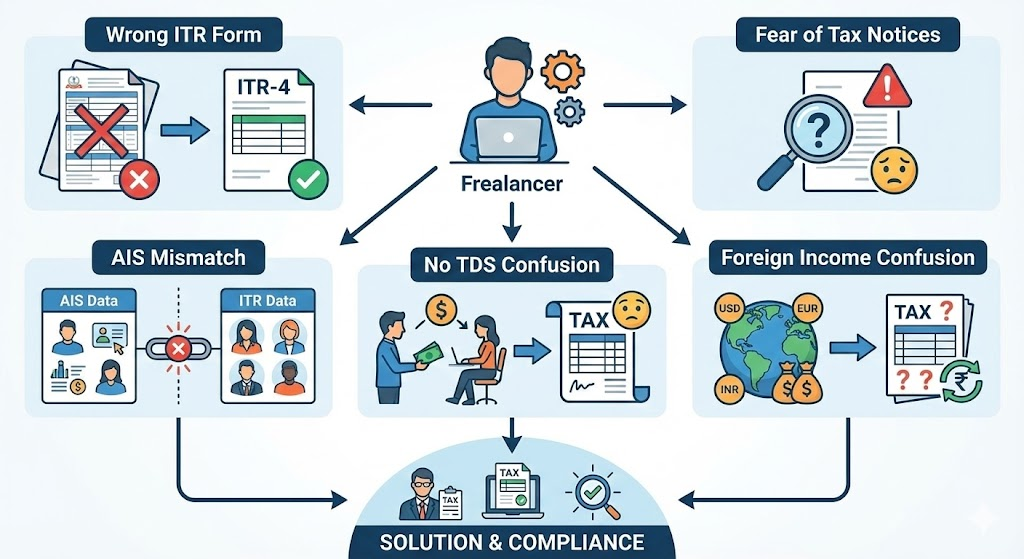
Additionally, platform-based income from Upwork, Fiverr, or foreign clients is heavily monitored. Failing to recognize this income creates long-term compliance risks.
The opportunity is clear. When freelancers file ITR correctly, they unlock loans, visas, credit cards, and scalable career growth.
Who Is Considered a Freelancer Under Indian Income Tax Law?
A freelancer in India is any individual earning income independently by providing professional or commercial services without an employer-employee relationship. Freelancers are taxed under “Profits and Gains from Business or Profession” and not under salary income, even if payments are fixed or recurring.
Under the Income Tax Act, freelancers are treated as self-employed individuals. The law does not use the word “freelancer.” Instead, it classifies income based on nature.
If you provide services independently and raise invoices, you are a freelancer. Payment frequency does not matter. Client location does not matter either.
Common freelance professions include digital marketers, web developers, graphic designers, content writers, video editors, consultants, and trainers.
Most beginners get this wrong by assuming a fixed monthly income equals a salary. That assumption is legally incorrect and risky. If you are just starting out, understanding the basics of how to start a freelance business in India is crucial to avoid these initial classification errors.
If no PF, no Form 16, and no employment contract exists, your income is not salary.
How Freelance Income Is Taxed in India (Business vs Profession)
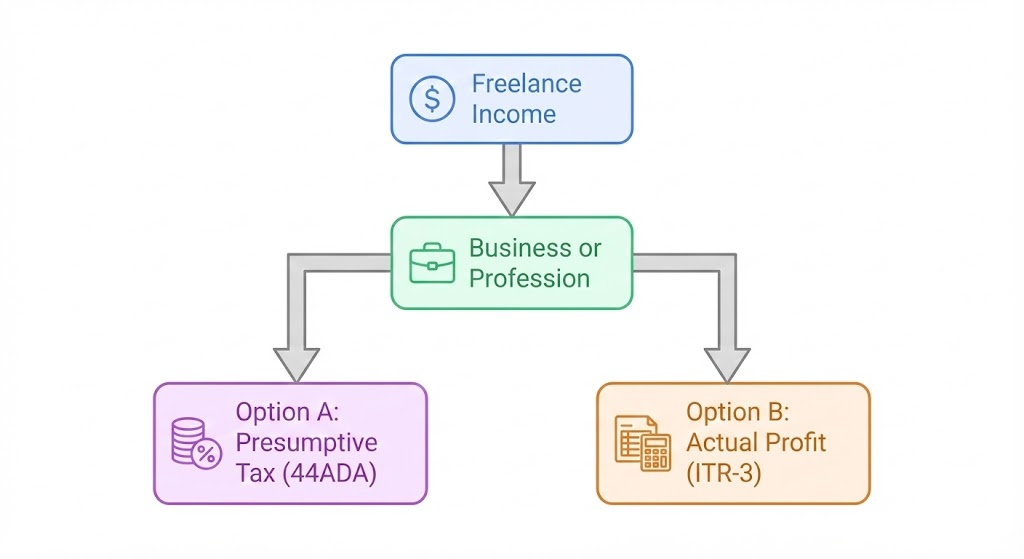
Freelance income in India is taxed under “Profits and Gains from Business or Profession.” Professionals may opt for presumptive taxation under Section 44ADA, while others must declare actual income minus expenses. Freelance income is never shown under “Income from Other Sources.”
Freelancers fall under two broad categories: professionals and non-professionals. This distinction affects tax treatment and compliance.
Professional freelancers include lawyers, doctors, architects, consultants, and digital professionals. Their income qualifies under Section 44ADA.
Business freelancers include traders, resellers, or service providers outside the notified professions.
A common mistake is showing freelance income under “Income from Other Sources.” This triggers scrutiny because invoices and bank credits do not align.
GST registration does not decide income tax classification. Even without GST, freelance income remains business income.
Correct classification reduces tax legally and prevents future notices.
Which ITR Form Should Freelancers File in 2026? (ITR-3 vs ITR-4)
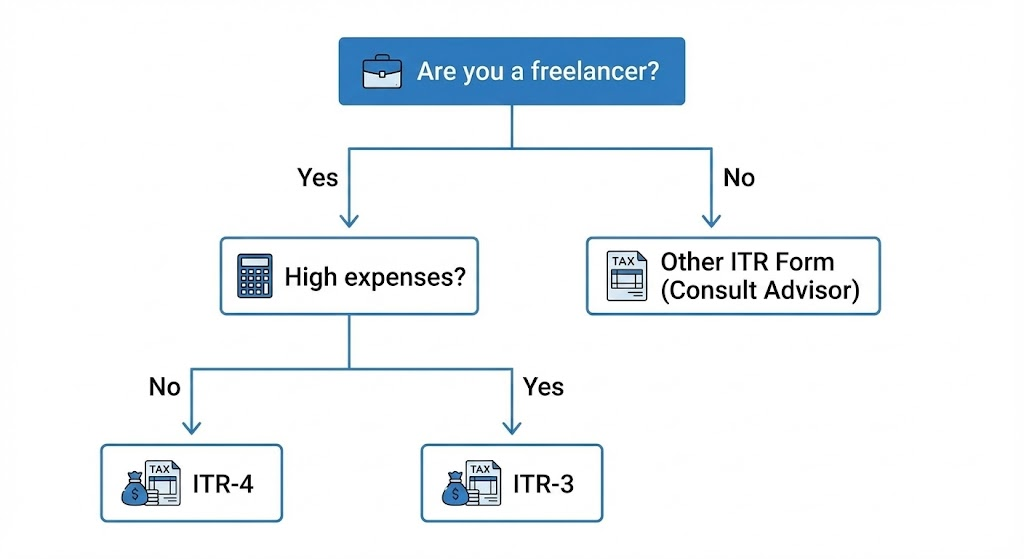
Freelancers must file either ITR-3 or ITR-4. ITR-4 applies if you opt for presumptive taxation under Section 44ADA. ITR-3 applies if you declare actual income and expenses. Freelancers cannot file ITR-1 in most cases.
Choosing the wrong ITR form is the biggest freelancer tax mistake. ITR-1 is only for salaried individuals with simple income.
If you earn freelance income, ITR-1 is usually invalid. Filing it can result in defective return notices.
ITR-4 is suitable when you choose presumptive taxation. It simplifies compliance but limits expense claims.
ITR-3 is ideal for freelancers earning higher income or claiming detailed expenses.
If you earn both a salary and freelance income, ITR-3 becomes mandatory.
Quick Comparison Table: ITR-3 vs ITR-4
| Criteria | ITR-3 | ITR-4 |
| For freelancers | Yes | Yes |
| Presumptive tax | No | Yes (44ADA) |
| Expense claiming | Detailed | Not allowed |
| Audit risk | Lower with proof | Lower if compliant |
| Best for | High-income freelancers | Simple compliance |
Many freelancers come from digital marketing backgrounds. If you are building income through online skills, understanding compliance is part of career growth.
You may find these guides helpful for long-term planning:
- What is Freelance Digital Marketing? A Beginner’s Guide
- How to Become a Freelance Digital Marketer in 2024?
- Unrevealing Benefits of LinkedIn for Freelancers
Case Study: Which ITR Saves You More Money? (Real Calculation)
Many freelancers blindly choose Section 44ADA (Presumptive Scheme), assuming it is always cheaper. This is not true. Let’s look at the math for a freelancer earning ₹20,00,000 (₹20 Lakhs) annually.
Scenario A: Low Expenses (e.g., Content Writer / Consultant)
- Total Income: ₹20,00,000
- Actual Expenses: ₹1,50,000 (Internet, Laptop depreciation)
- Choice: Section 44ADA (Presumptive Tax)
- Declared Income: $20,00,000 \times 50\% = 10,00,000$
- Taxable Income: ₹10,00,000
- Verdict: Since actual expenses are low, declaring 50% flat profit is beneficial.
Scenario B: High Expenses (e.g., Performance Marketer / Agency)
- Total Income: ₹20,00,000
- Actual Expenses: ₹12,00,000 (Ad spend, software subscriptions, team salaries)
- Choice: ITR-3 (Actual Profit Method)
- Calculation: $20,00,000 \text{ (Revenue)} – 12,00,000 \text{ (Expenses)} = 8,00,000$
- Taxable Income: ₹8,00,000
- Verdict: Here, ITR-3 wins. If this freelancer chose Section 44ADA, they would have been forced to pay tax on ₹10 Lakhs, overpaying significantly.
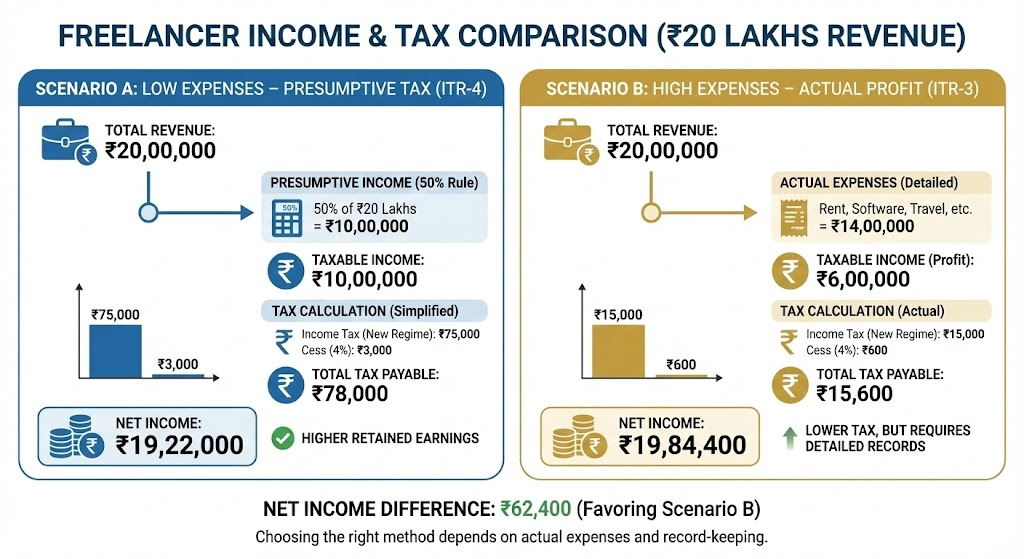
Note: Always calculate your “Net Profit Ratio” before selecting your form. To increase your profitability ratio, you should also review how to charge for digital marketing services to ensure your expenses don’t eat up your margins.
Step-by-Step Process to File ITR for Freelancers in India Online (2026)
If you want to understand how to file ITR for freelancers in India, the online filing process is now fully digital, AI-monitored, and data-linked. Freelancers must follow each step carefully because the Income Tax portal validates data instantly.
A small mismatch can delay refunds or trigger notices.
The first step is registering on the Income Tax e-Filing portal using your PAN. In 2026, PAN–Aadhaar linkage is mandatory. Without it, you cannot proceed. Many freelancers ignore this and get stuck at the final submission stage.
Next, select the correct assessment year and ITR form. Choosing ITR-3 or ITR-4 depends on whether you opt for presumptive taxation. This step defines your entire tax treatment.
After selecting the form, the system auto-fetches your AIS and TIS data. This includes bank interest, high-value transactions, and foreign remittances. Never ignore this data. Most freelancers get notices because they skip reconciliation.
Pro Tip: If you are learning how to get international clients, remember that foreign inward remittances are strictly monitored. Never ignore this data. Most freelancers get notices because they skip reconciliation.
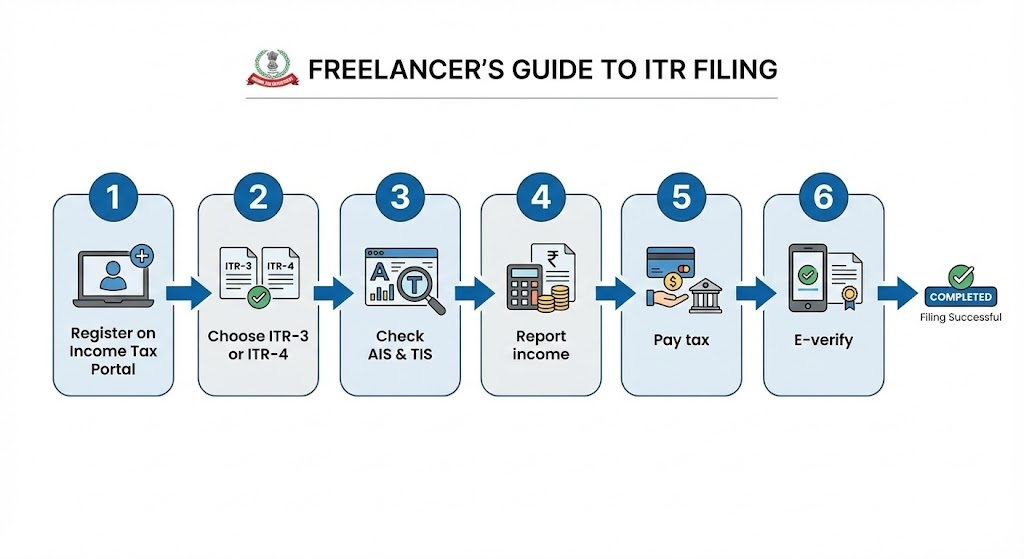
Finally, validate bank details, calculate tax, pay dues if any, and e-verify the return. Without e-verification, your ITR is considered invalid.
Online ITR Filing Checklist for Freelancers
- PAN and Aadhaar linked
- Active bank account validated
- Correct ITR form selected
- AIS and TIS reviewed
- Tax paid or refund confirmed
- E-verification completed
Following this checklist alone prevents 80% of freelancer tax issues.
How to Show Freelance Income in ITR Correctly (This Is Where Most Go Wrong)
Freelance income must be shown under “Income from Business or Profession,” either as presumptive income under Section 44ADA or as actual profit after deducting expenses. All receipts must align with AIS, bank credits, and invoices.
Showing freelance income correctly is more important than saving tax. In my experience, freelancers who underreport income face issues later when applying for loans or visas.
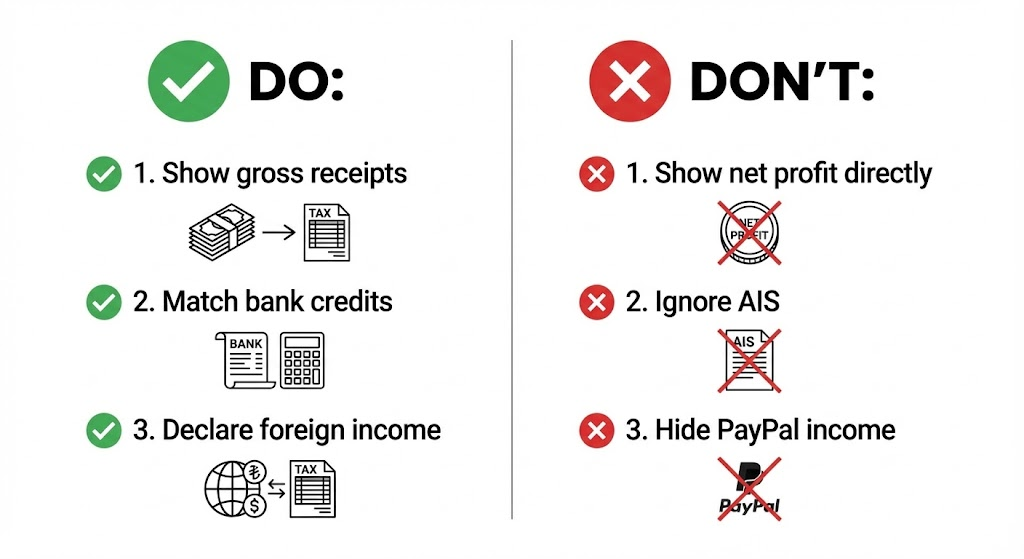
Freelancers must report gross receipts, not just profit. The system cross-checks deposits in your bank account with declared income. If numbers don’t match, scrutiny follows.
Foreign income must be disclosed even if tax is not deducted. Many freelancers believe PayPal or Wise income is invisible. That assumption is outdated.
Currency conversion must follow RBI reference rates. Arbitrary conversions raise red flags.
Most beginners get this wrong by reporting net income directly. That shortcut is risky.
Correct Way to Report Freelance Income
- Declare total invoices raised
- Match receipts with bank credits
- Convert foreign income properly
- Choose the correct profit method
- Maintain invoice records
If you work in digital services, this becomes even more important as platforms increasingly report income data.
For freelancers building long-term online careers, understanding income structure is as critical as skill growth. You may also explore:
Presumptive Taxation Under Section 44ADA: Is It Really Safe for Freelancers?
Section 44ADA allows eligible freelancers to declare 50% of gross receipts as taxable income without maintaining detailed expenses. It simplifies compliance but may increase tax if actual expenses are high.
Presumptive taxation looks attractive because it reduces paperwork. However, it is not always the best option. Many freelancers blindly opt for it without calculation.
Under Section 44ADA, you must declare at least 50% of your gross receipts as taxable income. This is a crucial nuance: if your actual profit is higher (e.g., 80%), you are legally required to declare the higher amount.
However, most freelancers stick to the 50% floor to maximize tax efficiency legally.
When does a Tax Audit become mandatory? Even if you are a freelancer, you are subject to a tax audit by a CA if you cross specific limits. As of 2026, you face a mandatory audit if:
- For Professionals: Your Gross Receipts exceed ₹75 Lakhs (if cash receipts are <5%).
- For Business/Traders: Your Gross Turnover exceeds ₹10 Crores (if cash receipts are <5%).
- Profit Declaration Mismatch: You earn above the basic exemption limit but declare a profit lower than 50% (for professionals) or 6-8% (for businesses) while opting out of the presumptive scheme.”
However, freelancers with high expenses often pay more tax under this scheme. This includes ads, software tools, teams, and office setups.
Another risk is income consistency. Once you opt for presumptive taxation, switching frequently raises suspicion.
In my consulting experience, Section 44ADA works best for solo freelancers with low expenses and stable income.
When 44ADA Works vs When It Backfires
| Scenario | Recommended |
| Low expenses | 44ADA |
| High tool costs | ITR-3 |
| Foreign clients | Case-dependent |
| Scaling freelancers | ITR-3 |
| Loan planning | ITR-3 preferred |
Choosing the wrong option can cost you more tax over time.
AIS & TIS Reconciliation: The Hidden Step Freelancers Ignore
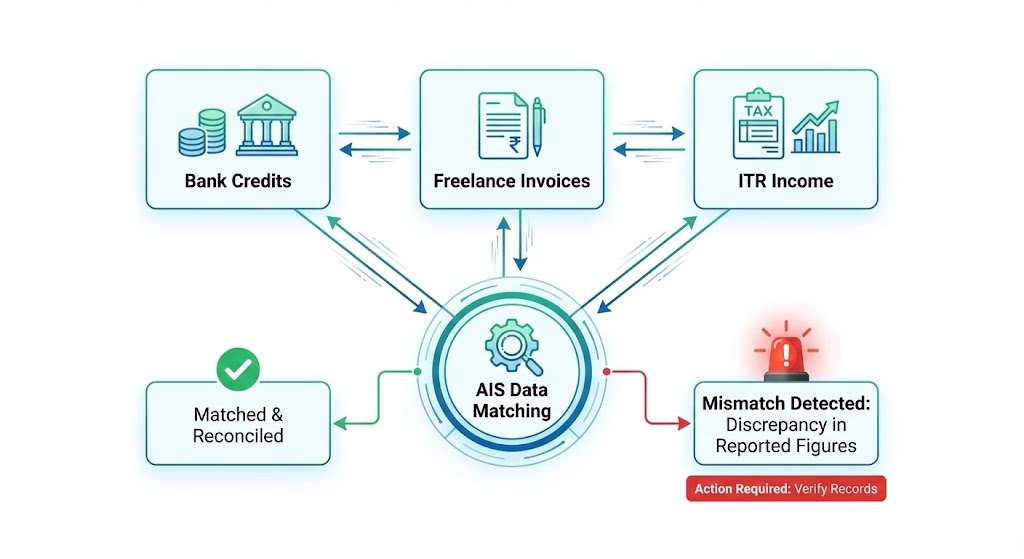
AIS (Annual Information Statement) is now the backbone of tax scrutiny. Every major transaction is tracked automatically.
Freelancers must review AIS before filing ITR. Ignoring mismatches is dangerous. The system compares your return with AIS data post-filing.
Common mismatches include bank interest, foreign remittances, and TDS entries. These must be corrected or justified.
TIS summarizes your taxable income. Treat it as a preview of what the department expects.
Freelancers who proactively align with AIS rarely receive notices.
Why Compliance Matters for Freelancers’ Career Growth?
Filing ITR correctly is not just about tax. It builds financial credibility. Banks, embassies, and platforms trust compliant freelancers.
As freelancers scale into consultants or agency owners, compliance becomes non-negotiable. Clean ITRs help unlock growth opportunities.
If you are serious about long-term freelancing or digital entrepreneurship, structured learning and mentorship matter. Programs with an AI-first curriculum and lifetime mentorship help freelancers grow their income while staying compliant.
You may also find value in:
Expenses Freelancers Can Legally Claim to Reduce Tax
If you truly want to master how to file ITR for freelancers in India, you must understand expense deductions. Freelancers often overpay taxes because they don’t claim legitimate expenses. In 2026, the tax department allows expense claims, but only when logic and documentation align.
Freelance income is taxed on profit, not revenue. This means expenses incurred to earn income are deductible. However, expenses must be reasonable, business-related, and proportionate.
Many freelancers fear claiming expenses due to audit myths. In reality, logical expense claims reduce scrutiny. Random or inflated claims invite trouble.
Expenses differ based on profession. A digital marketer’s expense structure differs from a consultant or developer. Understanding this nuance is critical.
Most beginners get this wrong by either claiming nothing or claiming everything. Both approaches are risky.
Common Freelance Expenses Allowed Under Income Tax
- Laptop and accessories (depreciation applicable)
- Internet and mobile bills
- Software subscriptions and tools
- Office rent or coworking space
- Marketing and advertising spend
- Professional courses and certifications
- Travel for client work
Home Office Expense Rule (Often Misused)
| Expense Type | Claim Allowed |
| Rent | Proportionate |
| Electricity | Proportionate |
| Internet | Full or partial |
| Furniture | Depreciation |
Claim only the portion used for work. Over-claiming here is a common audit trigger.
If you’re a digital professional investing in skills, this guide adds context:
Deductions & Tax-Saving Options for Freelancers in India
Freelancers can claim standard deductions under Chapter VI-A, such as 80C, 80D, and 80CCD. These deductions apply over and above business expense deductions and significantly reduce taxable income when planned early.
Freelancers often believe deductions are only for salaried employees. That belief is incorrect. Self-employed individuals enjoy the same tax-saving options.
Section 80C allows deductions up to ₹1.5 lakh through PPF, ELSS, LIC, and tax-saving FDs. This remains the most basic tax-saving tool.
Section 80D allows health insurance deductions. Freelancers should prioritize this due to a lack of employer coverage.
NPS under Section 80CCD(1B) offers an additional ₹50,000 deduction. Most freelancers ignore this powerful option.
In my experience, freelancers who plan deductions in April save significantly more tax than those who react in March.
Popular Tax-Saving Deductions for Freelancers
| Section | Deduction |
| 80C | ₹1,50,000 |
| 80D | Health Insurance |
| 80CCD(1B) | ₹50,000 |
| 80G | Donations |
| 80E | Education loan interest |
Tax planning is part of income scaling. Freelancers aiming for long-term growth must integrate finance with career decisions.
You may also explore:
Advance Tax Rules Freelancers Must Follow (Ignored at a Cost)
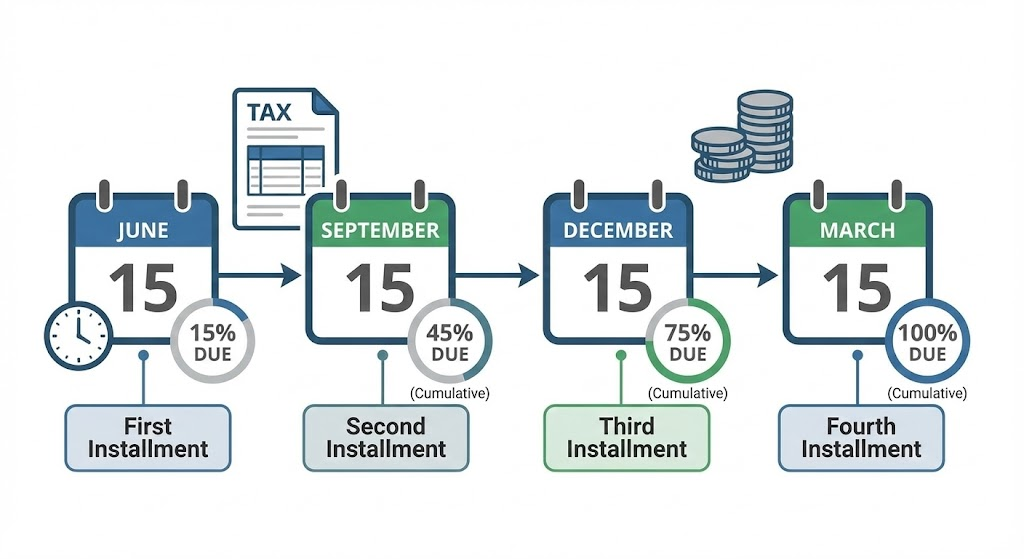
Freelancers must pay advance tax if the total tax liability exceeds ₹10,000 in a financial year. Advance tax is paid in quarterly installments. Failure attracts interest under Sections 234B and 234C.
Advance tax is not optional. Freelancers earning consistent income must pay tax during the year, not at filing time.
The biggest misconception is waiting until March. This results in interest penalties even if tax is paid later.
Advance tax improves cash flow discipline. It also reduces year-end stress.
Freelancers using Section 44ADA can pay advance tax in one installment by March 15. Others must follow quarterly schedules.
Ignoring advance tax is one of the most expensive freelancer mistakes.
Advance Tax Dates for Freelancers
- 15 June – 15%
- 15 September – 45%
- 15 December – 75%
- 15 March – 100%
Missing these dates attracts automatic interest. The system does not waive penalties easily.
Common Mistakes Freelancers Make While Filing ITR
The most common freelancer mistakes include choosing the wrong ITR form, ignoring AIS data, not paying advance tax, and misclassifying income. These errors trigger notices even when the income is genuine.
The biggest mistake is filing ITR-1 despite freelance income. This often leads to defective return notices.
Another frequent error is ignoring AIS mismatches. The department assumes undisclosed income when mismatches remain unresolved.
Some freelancers skip filing altogether if income is below taxable limits. This hurts credit history and future opportunities.
Others rely blindly on CAs without understanding filings. Responsibility always lies with the taxpayer.
In my experience, freelancers who understand the basics rarely face issues, even at higher income levels.
Mistakes That Trigger Tax Notices
- Wrong ITR selection
- Undisclosed foreign income
- Zero income filing despite bank credits
- No advance tax payment
- Inflated expense claims
Avoiding these mistakes protects both income and reputation.
Why Financial Discipline Matters for Freelancers’ Long-Term Growth?
Freelancing is not just short-term income. It is a career path. Clean tax records enable business loans, global opportunities, and scaling.
Many freelancers eventually transition into consultants, agency owners, or educators. Financial discipline supports that evolution.
Structured learning, mentorship, and AI-driven skill upgrades accelerate growth. Programs offering an AI-first curriculum with lifetime mentorship help freelancers align income, skills, and compliance.
For deeper career planning, explore:
Best Apps and Platforms to File ITR for Freelancers in India
If you are learning how to file ITR for freelancers in India, choosing the right platform is the final critical step. In 2026, freelancers can file returns either through the government portal or third-party platforms. Each option serves a different maturity level.
The Income Tax e-Filing portal is the most authoritative platform. It directly integrates AIS, TIS, and bank validation. However, many freelancers find it overwhelming due to technical language and multiple validation steps.
Private ITR filing platforms simplify the process. They offer guided workflows, auto-calculation, and error alerts. These platforms are helpful for freelancers filing independently without CA support.
Mobile-based apps have gained popularity among gig workers. They allow document uploads, quick filing, and real-time status tracking. However, complex cases still require careful review.
In my experience, freelancers earning above ₹10 lakh should prefer platforms offering human review support.
Popular ITR Filing Options for Freelancers
- Income Tax Department e-Filing Portal
- Online tax filing platforms with freelancer support
- CA-assisted digital platforms
- Mobile apps for basic ITR filing
Platform choice should match income complexity, not convenience alone.
Free vs Paid Filing Options: What Freelancers Should Choose
Free ITR filing suits freelancers with simple income and presumptive taxation. Paid filing is recommended for higher-income, foreign clients, multiple deductions, or long-term financial planning.
Free filing options appear attractive but come with limitations. They work best for freelancers with one income source and Section 44ADA compliance.
Paid filing offers value beyond submission. It includes AIS reconciliation, expense mapping, and audit safety checks. These benefits matter as income grows.
Freelancers working with foreign clients or earning via platforms often need paid support to avoid reporting mistakes.
Many freelancers view paid filing as an expense. In reality, it is risk insurance.
In my consulting work, freelancers using paid filing save more tax and face fewer notices.
Comparison: Free vs Paid ITR Filing
| Criteria | Free Filing | Paid Filing |
| Cost | ₹0 | ₹1,000–₹5,000 |
| AIS review | Limited | Detailed |
| Expense mapping | Basic | Advanced |
| Human support | No | Yes |
| Best for | Beginners | Scaling freelancers |
Choosing correctly saves time and stress.
Proprietary Frameworks Introduced for Freelancer ITR Success
Over the years, I have developed frameworks to simplify freelancer tax compliance. These models are based on real-world filing patterns and scrutiny trends.
Frameworks matter because rules change, but systems remain. Freelancers need repeatable processes, not one-time fixes.
These frameworks help freelancers file accurately, reduce risk, and align taxes with career growth.
Below are the three proprietary models used by high-performing freelancers.
F.R.E.E. Method™ (Freelancer Return Efficiency Engine)
Over the last 7 years, I have developed a proprietary framework to help freelancers file without errors. We call this the F.R.E.E. Method™.
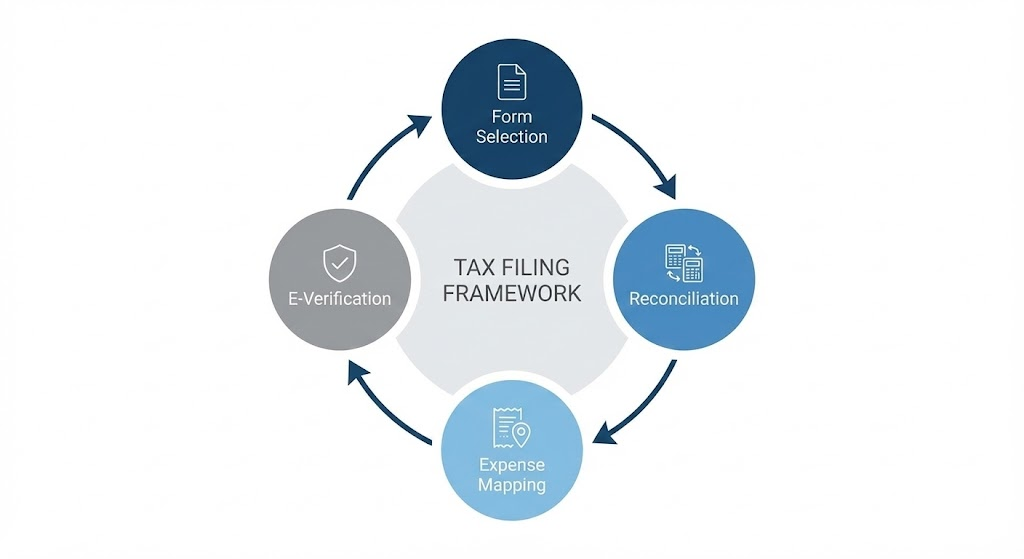
1. F – Form Selection: Do not auto-select ITR-4. Analyze your expense ratio first. If expenses > 50%, pick ITR-3. If expenses < 50%, pick ITR-4. This single step prevents 90% of defective notices.
2. R – Reconciliation (The AIS Check): Before filling a single digit, download your AIS (Annual Information Statement). Your declared “Gross Receipts” must match or exceed the total credit entries shown in AIS. Mismatches here trigger automatic AI notices.
3. E – Expense Mapping: Group your expenses into “Audit-Safe Categories.” Instead of “Miscellaneous,” use specific heads like “Server Costs,” “SaaS Subscriptions,” or “Professional Development.” Logical categorization reduces scrutiny.
4. E – E-Verification: A return filed but not verified is invalid. Ensure your Aadhaar is linked to your mobile for instant OTP verification to close the loop immediately.
A.I.S. Proofing Model™
The A.I.S. Proofing Model™ ensures your ITR matches government data sources. In 2026, this alignment is non-negotiable.
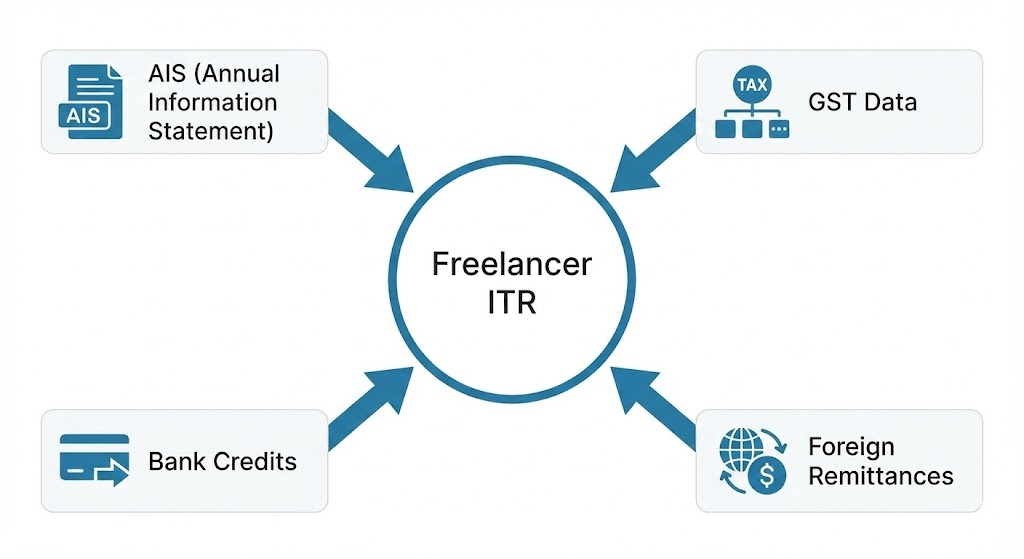
AIS tracks bank interest, foreign remittances, and high-value transactions. Ignoring it leads to mismatch notices.
This model forces freelancers to reconcile income before filing, not after receiving notices.
It also considers GST data where applicable, ensuring consistency across departments.
Freelancers using this model stay ahead of AI-based scrutiny systems.
Tax-to-Wealth Flywheel™
The Tax-to-Wealth Flywheel™ reframes tax compliance as a growth tool. Clean ITRs create financial leverage.
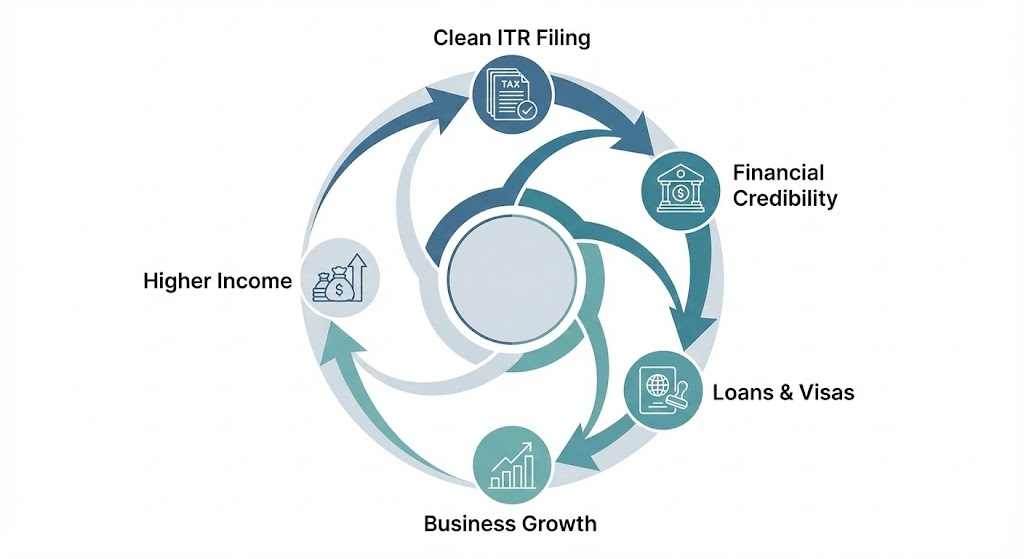
Banks evaluate ITRs for loans and credit. Embassies rely on them for visas. Platforms assess credibility using income records.
Freelancers who file correctly build a financial history. That history compounds over time.
This flywheel converts compliance into opportunity. Most freelancers never realize this advantage.
Those planning long-term careers benefit the most.
For freelancers scaling digital careers, these guides offer additional clarity:
- How to Start a Digital Marketing Agency in 2026
- Is Digital Marketing a Good Career in 2026?
- Digital Marketing Career Roadmap for Beginners 2026
Conclusion: Filing ITR as a Freelancer Is a Career Skill, Not a Task
Learning how to file ITR for freelancers in India is no longer optional in 2026. It is a foundational career skill. Freelancers who treat taxes casually remain stuck. Those who master compliance scale faster.
Correct ITR filing protects income, builds credibility, and unlocks growth. It also reduces mental stress and financial uncertainty.
Freelancers must stop copying salaried tax strategies. Independent income requires independent thinking.
With the right process, tools, and mindset, tax filing becomes predictable and manageable.
If you aim to grow beyond freelancing into consulting or entrepreneurship, combine compliance with skill upgrades. Structured programs with an AI-first curriculum and lifetime mentorship accelerate both income and confidence.
Your income deserves structure. Your career deserves clarity.
FAQs: Freelancer ITR Filing in India
How to file ITR if you are a freelancer in India?
A freelancer in India must file ITR by reporting income under “Profits and Gains from Business or Profession.” Choose ITR-3 or ITR-4, reconcile income with AIS, declare gross receipts, deduct eligible expenses or opt for Section 44ADA, pay due tax, and e-verify the return online.
Which ITR form is best for freelancers?
The best ITR form for freelancers is ITR-4 if opting for presumptive taxation under Section 44ADA. If declaring actual income and expenses or earning a salary plus freelance income, ITR-3 is the correct form. ITR-1 is usually not applicable.
Can freelancers file ITR-1?
In most cases, freelancers cannot file ITR-1 because freelance income is treated as business or professional income. ITR-1 is only for salaried individuals with simple income. Filing ITR-1 with freelance income can lead to defective return notices.
Is ITR-3 or ITR-4 better for freelancers?
ITR-4 is better for freelancers with simple income who choose presumptive taxation under Section 44ADA. ITR-3 is better for freelancers with high expenses, foreign income, or mixed income sources. The choice depends on income structure, not convenience.
How to show freelance income in ITR?
Freelance income must be shown under “Income from Business or Profession.” Declare total gross receipts, then either deduct actual expenses (ITR-3) or declare 50% income under Section 44ADA (ITR-4). Income should match bank credits and AIS data.
Do freelancers need to pay advance tax?
Yes, freelancers must pay advance tax if the total tax liability exceeds ₹10,000 in a financial year. Advance tax is paid quarterly. Freelancers under Section 44ADA can pay the full amount by March 15. Non-payment attracts interest penalties.
Can I file a freelancer ITR for free online?
Yes, freelancers can file ITR for free using the official Income Tax e-Filing portal if income and deductions are simple. However, freelancers with foreign income, high expenses, or AIS mismatches often benefit from paid platforms or professional assistance.
What documents are required to file ITR as a freelancer?
Freelancers need PAN, Aadhaar, bank statements, invoices raised, expense proofs, AIS/TIS details, Form 26AS, investment proofs for deductions, and foreign income statements if applicable. Proper documentation ensures smooth filing and reduces scrutiny risk.
How are foreign freelance payments taxed in India?
Foreign freelance payments are fully taxable in India if you are a resident. Income must be reported in INR using RBI reference rates. Even if no TDS is deducted abroad, income must be disclosed and aligned with bank credits and AIS data.
Do freelancers pay tax if their income is below ₹5 lakh?
Freelancers with income below ₹5 lakh may not pay tax due to rebate under Section 87A. However, filing ITR is still recommended to maintain financial records, claim refunds, and support loans, visas, and future income growth.
How to file an income tax return for freelancers in India online?
Register on the Income Tax e-Filing portal, select the correct assessment year and ITR form (ITR-3 or ITR-4), reconcile AIS data, report freelance income, claim deductions, pay tax if applicable, and e-verify the return digitally.
Best apps to file ITR for freelancers in India?
Freelancers can use the Income Tax e-Filing portal, CA-assisted online platforms, or mobile tax apps. Government portals offer free filing, while private apps provide guided workflows, AIS checks, and human review for complex cases.
Step-by-step guide to filing ITR for freelancers with business income?
Identify income type, choose ITR-3 or ITR-4, compile invoices and expenses, reconcile AIS, calculate taxable income, pay advance or self-assessment tax, submit return online, and complete e-verification to validate the filing.
Which platforms offer easy ITR filing for Indian freelancers?
Indian freelancers can use the official Income Tax portal for free filing or private digital platforms offering simplified dashboards, document uploads, and expert review. Platform choice should depend on income complexity and compliance needs.
How to use government portals for freelancer ITR filing?
Log in to the Income Tax e-Filing portal using PAN, select “File Income Tax Return,” choose the correct ITR form, review AIS data, enter income details, submit the return, and complete Aadhaar OTP or net-banking e-verification.
Documents required to file ITR as a freelancer in India?
Required documents include PAN, Aadhaar, bank statements, invoices, expense bills, AIS/TIS summary, Form 26AS, investment proofs, and foreign income records if applicable. These documents ensure accurate income reporting.
Can I file ITR for freelancing income on mobile apps?
Yes, freelancers can file ITR using mobile tax filing apps for simple cases. However, freelancers with foreign income, multiple deductions, or higher turnover should review filings carefully or use platforms offering expert assistance.
How to claim deductions while filing a freelancer ITR in India?
Freelancers can claim business expenses first, then Chapter VI-A deductions such as 80C, 80D, and 80CCD. Deductions must be backed by proof and planned early to reduce taxable income legally.
Top-rated ITR filing services for freelancers in India?
Top-rated services include CA-assisted online platforms, freelancer-focused tax portals, and advisory services offering AIS reconciliation, expense mapping, and audit-safe filing. Paid services are ideal for scaling freelancers.
How to register and file ITR on official tax websites for freelancers?
Visit the Income Tax e-Filing website, register using PAN and Aadhaar, create login credentials, select the relevant ITR form, enter freelance income details, submit the return, and complete e-verification to finalize filing.






1 thought on “How to File ITR for Freelancers in India: Step-by-Step Guide”
Informative and practical guide! Filing ITR as a freelancer can be confusing, especially with different forms, TDS, GST, and advance tax rules, but this article breaks it down clearly. It’s really useful for anyone working independently in India to understand how to stay compliant and make the most of available deductions. Great resource for freelancers looking to manage their taxes confidently!