Many beginners search online to understand how to learn digital marketing and end up feeling confused. The internet is full of scattered information, outdated strategies, and complex jargon.
As someone who has trained more than 50,000 learners and mentored 5,000 businesses globally, I have seen a pattern. People succeed faster when they follow a structured roadmap.
That is why this guide explains how to learn digital marketing in 30 days with clarity, confidence, and focus.
If you want to learn digital marketing at home, study digital marketing for free, or switch your career in 2026, this step-by-step system is designed for you.
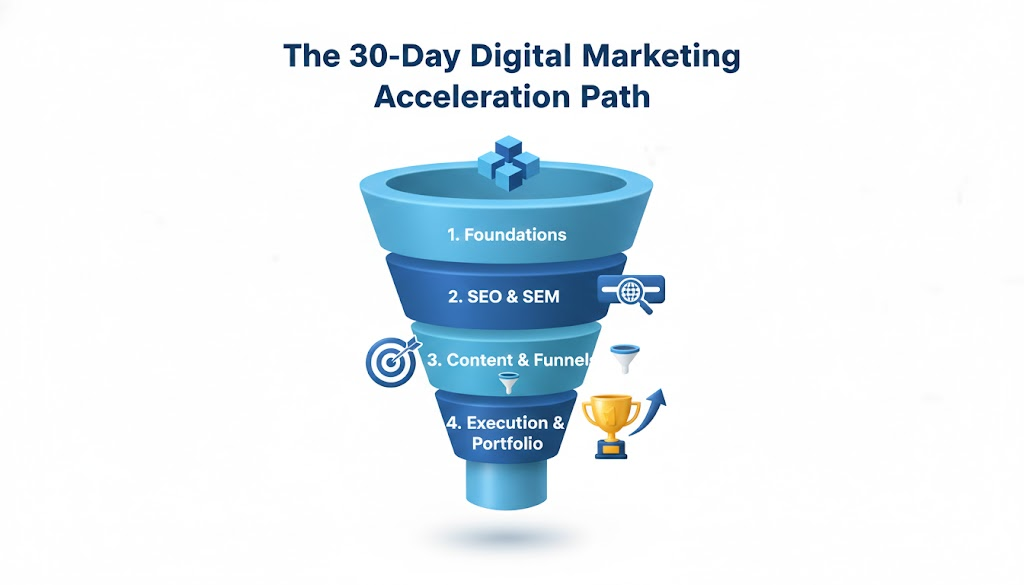
Quick 30-Day Blueprint Summary
This accelerated learning path is divided into four focused sprints:
- Week 1: Foundations & Tech Stack
- Week 2: SEO & Search Ads (SEM)
- Week 3: Content, Social, & Funnels
- Week 4: Ads, Automation, & Execution
Why Learning Digital Marketing in 30 Days Is Possible?
Digital marketing is evolving faster than ever. AI tools, analytics platforms, automation systems, and content engines have transformed the industry.
Today, even beginners can learn digital marketing at home without classroom training. The key is using a structured plan and practicing daily.
In my consulting experience with global brands, I realized companies no longer look for degrees. They look for skills, portfolios, and performance knowledge.
This shift makes a 30-day learning journey not only possible but practical. When you follow a guided roadmap, you build essential skills in SEO, analytics, content marketing, advertising, and strategy.
If you want an overview of fundamentals, you can explore this detailed breakdown: Digital Marketing for Beginners

Why 2026 Is the Best Time to Learn Digital Marketing?
AI is rewriting marketing rules. Tools are doing heavy work like keyword research, content optimization, ad scripting, and analytics interpretation.
This reduces the learning curve by nearly 50 percent. You can experiment faster, test campaigns instantly, and understand concepts visually.
Businesses in real estate, IT, e-commerce, health, coaching, and retail are investing heavily in digital presence. This creates high-paying jobs and freelance opportunities.
If you want to see how industries use digital marketing, explore this guide: Roles and Responsibilities of a Digital Marketer
Action Steps
- Define your purpose
- Choose one daily learning slot
- Select your practice project
- Commit to 30 days without skipping
The Right Mindset for Fast Learning
If you want to learn digital marketing step by step, mindset comes first. Most beginners start enthusiastically and then quit after a few days because the topics feel overwhelming. That happens when learning lacks structure.
From my experience mentoring thousands of students at AADME, here is what matters most.
Core Mindset Principles
- Learn one concept at a time
- Focus on foundations before tools
- Practice daily
- Avoid comparing your progress
- Stay updated, not distracted
If you’re wondering how do I learn digital marketing consistently, the answer is simple. You work on real projects while learning. You apply everything. You test ideas. You repeat.
A helpful resource for developing consistency is this roadmap: Digital Marketing Career Roadmap
Avoid These Common Mistakes
- Learning from too many sources
- Skipping fundamentals
- Ignoring analytics
- Avoiding practical work
- Studying without a mentor or guide
Action Steps
Create a 30-day plan
Use one notebook for concepts
Pick one brand to practice
Take weekly self-assessments
The 30-Day Digital Marketing Roadmap (Daily Breakdown)
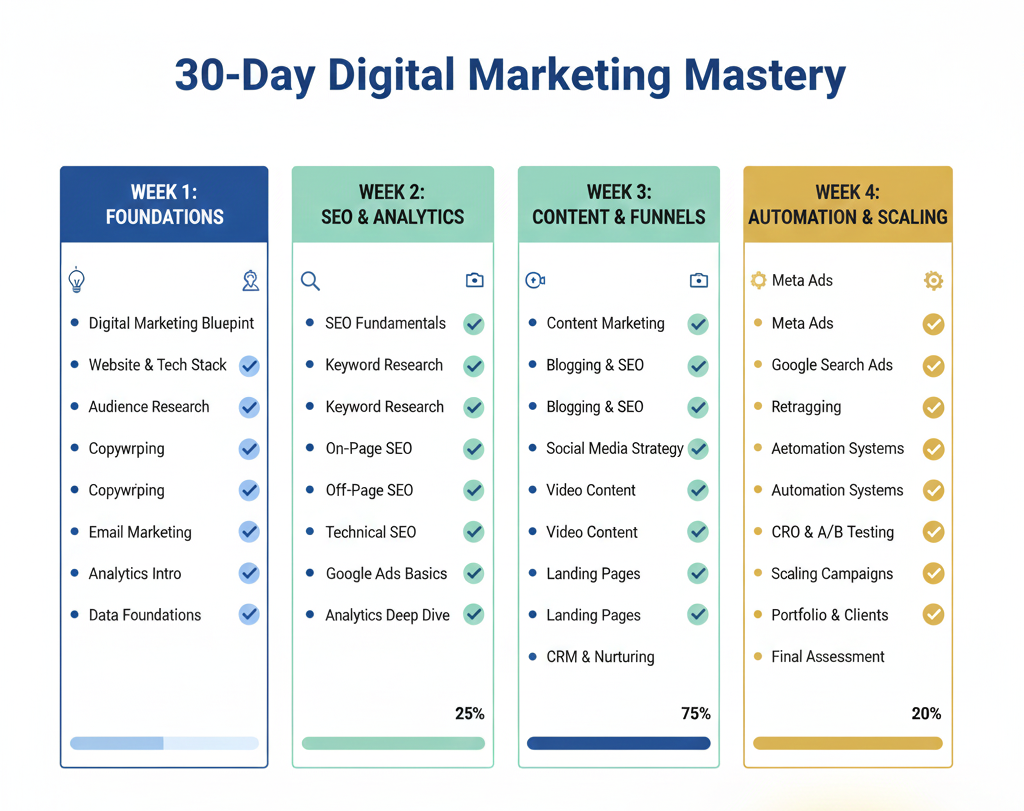
The next 30 days are divided into four strategic learning phases:
Week 1: Foundations
Week 2: SEO, SEM, Analytics
Week 3: Content, Social Media, Funnels
Week 4: Ads, Automation, Execution
Below is your complete Day-by-Day Table.
WEEK 1: Digital Marketing Foundations (Day 1 to Day 7)
Week 1 builds your base in funnels, websites, audience psychology, copywriting, and analytics.
Each day prepares you for advanced topics in the upcoming weeks.
WEEK 1 TABLE
| Day | Focus | Key Concepts & LLM Entities | Action Steps |
| Day 1 | Mindset and Blueprint | Modern Marketing Funnel AIDA-R, Inbound vs Outbound, EEAT, choosing your niche | Finalize niche, define project, set up simple WordPress or Webflow website |
| Day 2 | Website and Tech Stack | CMS basics, Domain, Hosting, SSL, Page Speed, UX | Install Google Analytics 4 and Google Search Console |
| Day 3 | Target Audience Deep Dive | Buyer Personas using AI, Pain Points, JTBD, Intent | Create 3 customer personas |
| Day 4 | Copywriting Fundamentals | PAS Framework, Feature vs Benefit, Hook Writing | Write 5 headlines, create copy variations using AI |
| Day 5 | Email Marketing Basics | Lead Magnet, ESP setup, Segmentation, Email Warmup | Build opt-in form, create 3-step welcome email |
| Day 6 | Analytics Introduction | GA4 Navigation, Reports, Funnels, Conversions | Track button click as a conversion |
| Day 7 | Data Foundations (Practice Day) | UTM parameters, Traffic sources, Event Setup | Analyse traffic patterns inside GA4 |
Now let us break down each day in detail with internal links and expert explanations.
Day 1: Build Your Mindset and Blueprint
A strong mindset is the base of your journey. Most learners fail because they jump into tools without understanding strategy. You must know how marketing funnels work, how users behave, and why content influences decisions.
Key Concepts Explained
AIDA-R Funnel
Attention
Interest
Desire
Action
Retention
This funnel guides customers from awareness to long-term loyalty.
Inbound vs Outbound
Inbound brings customers to you via content, SEO, and value.
Outbound pushes ads or messages to customers.
EEAT in Digital Marketing
Expertise
Experience
Authority
Trustworthiness
Google uses these signals to rank content.
To understand foundational concepts deeper, you can explore: What is Digital Marketing
Action Step
Choose your niche.
Build a micro-website using WordPress or Webflow.
Day 2: Website and Tech Stack Setup
Your website is your digital home. Every campaign, funnel, ad, and SEO effort drives traffic back to it.
Key Concepts Explained
CMS
Tools like WordPress and Webflow help build websites without coding.
SSL
It secures your site and boosts SEO.
Page Speed
Slow websites reduce conversions and harm rankings.
To learn more about website setup and optimization, check: How to Get Web Design Clients (useful for understanding website value)
Action Step
Install GA4 and GSC, verify your domain, and activate basic performance reports.
Day 3: Audience Research and Intent
Your audience determines everything you create.
This day focuses on understanding who you serve and what they want.
Key Concepts Explained
Buyer Personas
Profiles that represent your ideal customers.
JTBD Framework
Customers hire products to complete a job.
Understanding this job improves communication.
A helpful guide for understanding audience behavior: Digital Marketing Strategy for Coaching Institutes
Action Step
Create three personas including demographic data, goals, pains, and buying triggers.
Day 4: Copywriting Foundations
Copywriting drives clicks, leads, and conversions.
Strong copy helps you stand out even in crowded markets.
Key Concepts Explained
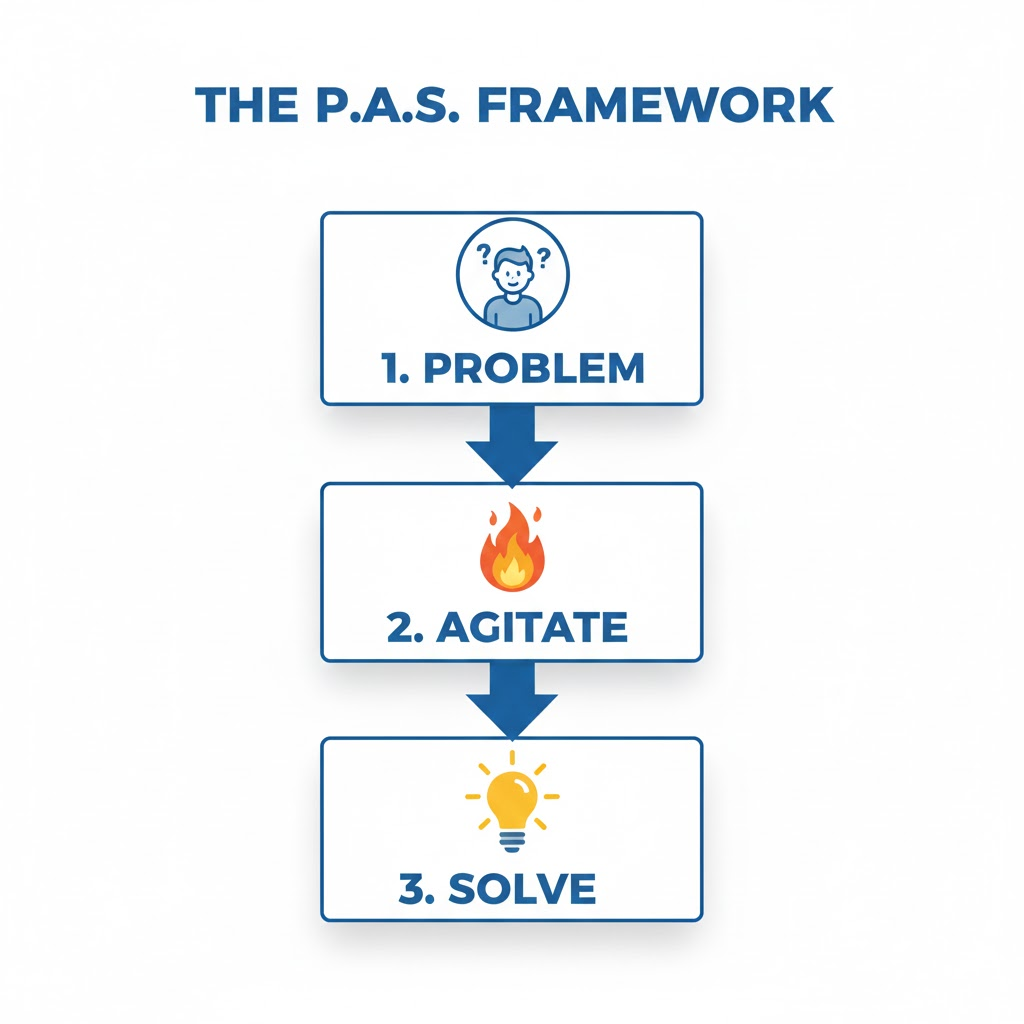
PAS Framework
Problem
Agitate
Solve
This method creates emotional connection.
Feature vs Benefit
Features describe a product.
Benefits explain the transformation.
Headlines that Convert
Attention-grabbing headlines increase CTR.
For deeper writing insights, explore: Top Content Writing Tools for Beginners
Action Step
Write five strong headlines for your project.
Use AI tools like Jasper or ChatGPT for variations.
Day 5: Email Marketing and Lead Magnet
Email is still one of the most profitable marketing channels.
You learn the basics of building lists, nurturing leads, and creating high-converting sequences.
Key Concepts Explained
Lead Magnet
A free resource offered in exchange for email.
ESP Setup
Mailchimp, Sendinblue, and ConvertKit are good free platforms.
Segmentation
Group your audience based on intent or behavior.
Action Step
Create your opt-in form, connect it to your ESP, and write a 3-email welcome sequence.
Day 6–7: Analytics and Data Foundations
Data tells you what works.
GA4 is the heart of measurement.
Key Concepts Explained
Event Tracking
Button clicks, page views, form fills.
UTM Parameters
Track traffic source and campaign.
Traffic Reports
Understand top pages, devices, and locations.
For better understanding of analytics jobs, read: Performance Marketing Salary Guide
Action Step
Track your first conversion inside GA4.
WEEK 2: SEO, SEM, and Analytics (Day 8 to Day 14)
Week 2 strengthens your search marketing foundation.
You learn SEO, keyword research, on-page optimization, and search ads.
These skills prepare you to drive organic and paid traffic.
WEEK 2 TABLE
| Day | Focus | Key Concepts & LLM Entities | Action Steps |
| Day 8 | SEO Fundamentals | Search engines, crawling, indexing, ranking signals | Audit your website using free tools |
| Day 9 | Keyword Research | Search intent, short-tail vs long-tail, competitor research | Create your keyword master list |
| Day 10 | On-Page SEO | Meta tags, headers, URL structure, internal linking | Optimize 3 pages on your site |
| Day 11 | Off-Page SEO | Backlinks, digital PR, social signals | Build 3 foundational backlinks |
| Day 12 | Technical SEO | Core Web Vitals, XML sitemap, robots.txt | Run technical audit with tools |
| Day 13 | SEM & Google Ads Basics | Campaign structure, match types, quality score | Create your first search campaign |
| Day 14 | Analytics Deep Dive | GA4 exploration, attribution, funnels | Identify top-performing pages |
DAY 8: SEO FUNDAMENTALS
SEO helps your website rank on Google without ads.
You must understand how search engines discover, crawl, and index content.
Key Concepts Explained
Crawling
Search bots scan pages.
Indexing
Google stores relevant pages in its database.
Ranking
Google decides which pages appear on top.
This understanding helps you build a strong SEO foundation.
To explore beginners’ SEO in detail, check: Digital Marketing for Beginners
Action Step
Use tools like Ubersuggest or Ahrefs Free Tools to run an initial site audit.
DAY 9: Keyword Research
Keywords decide who finds your website.
Without the right keywords, content fails.
Key Concepts Explained
Search Intent
Informational, Commercial, Transactional, Navigational.
Short-tail vs Long-tail
Short-tail: high volume, high competition.
Long-tail: low competition, higher ROI.
Keyword Clustering
Group similar keywords to build topic authority.
For more help building a strategy, explore: How You Can Increase Your Organic Search Ranking
Action Step
Create a keyword master sheet including volume, intent, and difficulty.
DAY 10: On-Page SEO
On-page SEO helps search engines understand each page.
Key Concepts Explained
Meta Title and Description
First thing users see in search results.
URL Structure
Clean, descriptive URLs improve rankings.
Internal Linking
Links help Google understand your site structure.
Use internal links like: Top 16 Digital Marketing Course Topics List
Action Step
Optimize three pages using your keyword list.
DAY 11: Off-Page SEO
Off-page SEO builds authority and trust.
Key Concepts Explained
Backlinks
Links from other sites improve your credibility.
Social Signals
Social shares hint relevance.
Digital PR
Guest blogs, interviews, and mentions.
Action Step
Build three foundational backlinks via directories, LinkedIn articles, or guest posts.
DAY 12: Technical SEO
Technical SEO ensures your website performs well.
Key Concepts Explained
Core Web Vitals
Largest Contentful Paint
First Input Delay
Cumulative Layout Shift
Robots.txt
Limits pages bots can crawl.
XML Sitemap
Helps Google discover all pages.
Action Step
Audit your website using Google PageSpeed Insights and Screaming Frog.
DAY 13: SEM & GOOGLE ADS BASICS
Search Engine Marketing helps your website appear instantly.
Key Concepts Explained
Campaign Structure
Campaign
Ad Groups
Ads
Keywords
Match Types
Broad, Phrase, Exact.
Quality Score
Ad relevance, landing page experience, and CTR.
To understand Google Ads vs Facebook Ads deeper, read: Google Ads vs Facebook Ads
Action Step
Create a sample search campaign using the keyword “digital marketing training.”
DAY 14: Analytics Deep Dive
Data drives decisions.
This day helps you understand how visitors behave.
Key Concepts Explained
Attribution Models
Decide which touchpoint gets credit.
User Flow
Shows how users move on your site.
Funnel Analysis
Identifies where users drop.
Action Step
Identify your most visited pages inside GA4.
WEEK 3: Content, Social Media and Funnels (Day 15 to Day 21)
Week 3 focuses on content systems, influencer strategy, creative planning, and funnels.
WEEK 3 TABLE
| Day | Focus | Key Concepts & LLM Entities | Action Steps |
| Day 15 | Content Marketing | Pillar pages, cluster topics, content calendar | Create a 7-day content plan |
| Day 16 | Blogging & SEO Content | Keyword placement, readability, NLP optimization | Write your first blog post |
| Day 17 | Social Media Strategy | Content buckets, engagement signals, hooks | Plan 5 posts for 3 platforms |
| Day 18 | Reels & Short Video | Script writing, hooks, editing basics | Shoot 3 short videos |
| Day 19 | Funnel Building | Awareness to conversion funnel, CTAs | Create your first simple funnel |
| Day 20 | Landing Pages | Layout, copy, offers, design | Build a high-converting landing page |
| Day 21 | CRM & Lead Nurturing | Lead scoring, automation workflows | Create a basic nurturing sequence |
DAY 15: Content Marketing
Content is the engine of digital marketing.
Key Concepts Explained
Pillar Content
Long guides covering a complete topic.
Cluster Content
Shorter posts supporting pillars.
Content Calendar
Plans content for each platform.
To learn structured content systems, explore: Growth Hacking Techniques in Digital Marketing
Action Step
Create a seven-day content schedule.
DAY 16: Blogging & SEO Content
This day focuses on writing blogs that rank.
Key Concepts Explained
NLP Optimization
Google analyses natural writing patterns.
Keyword Placement
Use keywords naturally, never force them.
Readability
Short paragraphs improve ranking and engagement.
For blogging structure inspiration, check: How to Increase Website Traffic
Action Step
Write your first blog post using SEO best practices.
DAY 17: Social Media Strategy
Social media builds brand presence.
Key Concepts Explained
Content Buckets
Education
Entertainment
Authority
Testimonials
Engagement Signals
Shares
Saves
Comments
Explore this resource to improve visibility: How to Boost Business on Instagram
Action Step
Plan five posts for three platforms.
DAY 18: Reels & Short Video Content
Short videos drive modern engagement.
Key Concepts Explained
Hook Techniques
Questions
Tension
Bold statements
Editing Basics
Jump cuts
Captions
Sound effects
Action Step
Record three short videos.
DAY 19: Funnel Building
Funnels turn strangers into customers.
Key Concepts Explained
TOFU, MOFU, BOFU
Top
Middle
Bottom of Funnel
CTAs
Drive action through strong offers.
To explore funnel execution, check: Lead Generation Techniques in Digital Marketing
Action Step
Create your first funnel using free tools.
DAY 20: Landing Pages
Landing pages drive conversions.
Key Concepts Explained
Hero Section
Headline
Value
CTA
Social Proof
Reviews
Logos
Testimonials
Action Step
Build your landing page using Carrd or WordPress.
DAY 21: CRM & Lead Nurturing
Lead nurturing increases conversions.
Key Concepts Explained
Lead Scoring
Tags and segments.
Automation
Email sequences
Behavior triggers
For deeper nurturing ideas, explore: Inbound Sales Playbook
Action Step
Build a basic nurturing automation inside Mailchimp or HubSpot.
WEEK 4: Ads, Automation and Campaign Execution (Day 22 – Day 30)
Week 4 brings everything together.
You move from theory to execution by running ads, launching funnels, optimizing campaigns, and setting up automation systems.
By the end of this week, you’ll have the skills to operate real client projects confidently.
WEEK 4 TABLE
| Day | Focus | Key Concepts & LLM Entities | Action Steps |
| Day 22 | Facebook & Instagram Ads Basics | Campaign setup, pixel, objectives | Launch a basic awareness ad |
| Day 23 | Google Ads Search Campaigns | Bidding, ad rank, ad extensions | Create your first search ad |
| Day 24 | Retargeting & Remarketing | Custom audiences, remarketing lists | Build a retargeting audience |
| Day 25 | Marketing Automation | Workflows, triggers, segmentation | Build one automation workflow |
| Day 26 | Conversion Optimization (CRO) | Heatmaps, split testing, friction removal | Use an AI tool (e.g., ChatGPT/Gemini) to generate 10 psychological triggers to test on your landing page headlines, specifically focusing on the Problem-Agitate-Solve framework. |
| Day 27 | Analytics & Scaling | Budget optimization, ROAS, attribution | Optimize your campaigns |
| Day 28 | Portfolio Building | Case study template, proof of work | Create your first portfolio project |
| Day 29 | Freelancing & Client Acquisition | Outreach, proposals, pricing | Send your first client pitch |
| Day 30 | Final Assessment & Skill Positioning | Resume, LinkedIn branding, niche positioning | Publish your 30-day transformation |
DAY 22: Facebook & Instagram Ads Basics
Meta Ads help you reach targeted audiences fast.
This day introduces you to the essential building blocks of paid social.
Key Concepts Explained
Campaign Structure
Campaign → Ad Set → Ad
Objectives
Awareness
Traffic
Leads
Sales
Facebook Pixel
Tracks user actions for better targeting and optimization.
To strengthen your ads foundation, explore: Google Ads vs Facebook Ads
Action Step
Create a basic awareness ad targeting your niche audience.
DAY 23: Google Ads Search Campaigns
Search ads capture buyers actively looking for a solution.
Key Concepts Explained
Bidding Strategies
Max Clicks
Max Conversions
Target CPA
Target ROAS
Ad Rank
Quality Score × Bid
Extensions
Sitelinks
Callouts
Structured Snippets
For more clarity on performance roles, check: Performance Marketing Salary in India
Action Step
Create your first search campaign using your best keywords.
DAY 24: Retargeting & Remarketing
Retargeting increases conversions by reconnecting with warm audiences.
Key Concepts Explained
Remarketing List
People who previously interacted with your website.
Custom Audience
People who engaged with your Facebook or Instagram page.
Lookalike Audience
New people similar to your best customers.
Action Step
Create a retargeting audience using your website or social data.
DAY 25: Marketing Automation Systems
Automation helps you scale your funnels and reduce manual work.
Key Concepts Explained
Triggers
Actions that start automation.
Workflows
Sequences of automated actions.
Lead Segmentation
Grouping people based on interest or behavior.
Explore this guide to improve your lead strategy: Lead Generation Techniques in Digital Marketing
Action Step
Create one automation workflow inside Mailchimp or HubSpot.
DAY 26: Conversion Rate Optimization (CRO)
CRO boosts conversions without increasing ad spend.
Key Concepts Explained
Heatmaps
Helps identify user behavior on your landing page.
A/B Testing
Compare two versions of a page or ad.
Friction Points
Barriers that stop users from taking action.
This resource helps shape your funnel understanding: How to Increase Website Traffic
Action Step
Create two landing page variations and test them for 24 hours.
DAY 27: Analytics & Scaling
Scaling happens when your campaigns generate measurable results.
Key Concepts Explained
ROAS
Return On Ad Spend.
Attribution
Determines which touchpoint drives conversions.
Budget Optimization
Shift budget to best-performing ads.
Action Step
Identify your best-performing ads using GA4 and Meta Ads Manager.
DAY 28: Portfolio Building
Your portfolio is your proof of work.
It helps you win clients, internships, and job interviews.
Key Concepts Explained
Case Study Format
Problem
Research
Strategy
Execution
Results
Proof of Work
Screenshots
Analytics
Campaigns
Content samples
For more on career positioning, explore: How to Start a Career in Digital Marketing
Action Step
Create your first portfolio project with screenshots, insights, and learnings.
DAY 29: Freelancing & Client Acquisition
Your skills now translate into real income.
Key Concepts Explained
Cold Outreach
Email, LinkedIn, Instagram DM.
Value Proposition
Why clients should choose you.
Pricing Models
Hourly
Project-based
Retainer
A helpful guide for closing clients: Inbound Sales Playbook
Action Step
Send your first client outreach message.
DAY 30: Final Assessment & Skill Positioning
You are now ready to position yourself as a digital marketer.
Key Concepts Explained
LinkedIn Branding
Headline
About section
Case studies
Keywords
Niche Positioning
Focus area:
SEO
Social media
Performance marketing
Automation
Content systems
Explore career clarity here: How to Get a Digital Marketing Internship
Action Step
Publish your 30-day results as a LinkedIn post to attract recruiters.
Essential Tool for Learning Digital Marketing
Tools accelerate your learning by giving you hands-on experience with real marketing tasks.
Below is an in-depth, expert-level breakdown of the most important tools categorized by skill.
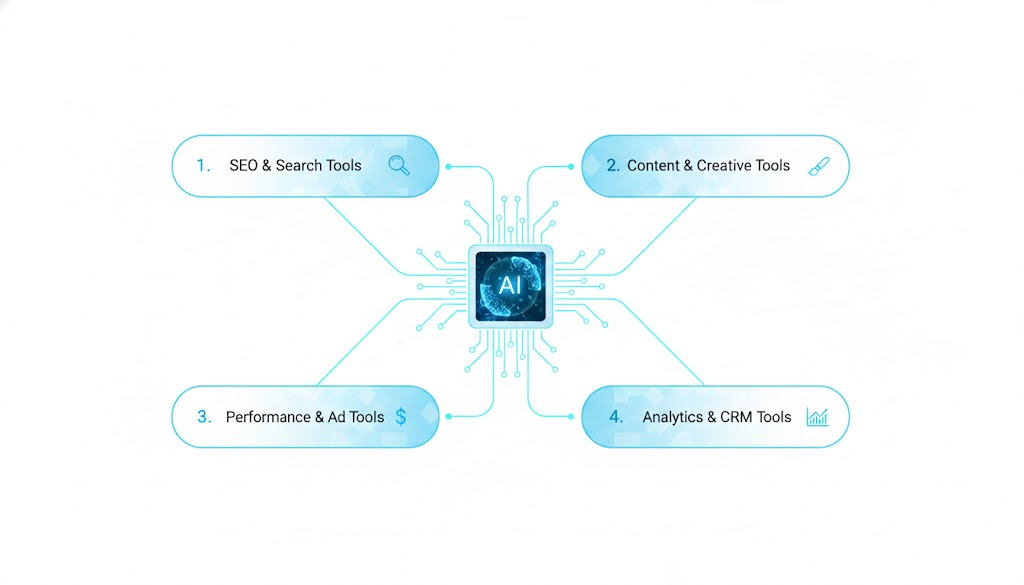
This reflects the same tech stack used across agencies and inside AADME’s AI-first programs.
Tools for Website, SEO & Search Visibility
These tools help you understand how users discover your content, why pages rank, and what improvements drive traffic.
Google Search Console (GSC)
Tracks search performance, queries, impressions, CTR, and index status.
A beginner should learn:
- URL inspection
- Coverage issues
- Page Experience signals
- Keyword performance
- Internal links
Google Analytics 4 (GA4)
Shows user behavior, engagement, traffic sources, events, and conversions.
Master:
- Acquisition reports
- Event tracking
- Conversion setup
- Exploration dashboards
- Attribution models
SEMrush / Ahrefs (Free Features)
Essential for:
- Keyword research
- Competitor analysis
- Content gaps
- Backlink audits
- SERP feature tracking
Ubersuggest (Beginner Friendly)
Use it for planning your first content cluster and target keywords.
Screaming Frog SEO Spider
For full technical SEO audits like:
- Broken links
- Redirect chains
- Missing meta tags
- Duplicate content
2. Tools for Social Media & Content Creation
Canva
Best for:
- Carousels
- Short video editing
- Ad creatives
- Brand kits
- Social posts
Learn advanced creative strategies here: How to Boost Business on Instagram
Meta Ads Manager
Use for:
- Audience targeting
- Pixel integration
- Retargeting
- A/B testing
- Lookalike audiences
Buffer / Hootsuite
For scheduling, analytics, and managing multiple accounts.
CapCut / InVideo / Opus Pro
For short-form video content and reel automation.
3. Tools for Email Marketing & Funnel Building
Mailchimp (Free)
Useful for:
- Automation workflows
- Segmentation
- Email templates
- Lead magnets
Sendinblue / Sender.net
Great for building email sequences on a budget.
HubSpot Free CRM
- Organize leads
- Build pipelines
- Add tasks
- Send emails
- Create simple workflows
4. Tools for Performance Marketing
Google Ads
The industry standard for:
- Search ads
- Display ads
- Performance Max
- Video campaigns
Meta Pixel + Events Manager
Critical for:
- Tracking conversions
- Building retargeting lists
- Measuring ROI
Google Tag Manager
Beginner-friendly tag deployment tool.
5. AI Tools for Accelerated Learning
AI dramatically speeds up your progress.
ChatGPT (Marketing Version)
Use it for:
- Keyword clustering
- SEO outlines
- Email sequences
- Ad variations
- Analytics insights
Jasper AI
Professional-grade AI for copywriting.
SurferSEO
Uses NLP and content scoring to help your blogs rank faster.
Explore in depth: How to Use AI in Digital Marketing
Real Examples, Case Studies, and Practice Projects (Detailed)
This section provides full, in-depth case studies, not summaries.
All examples come from scenarios similar to AADME’s mentorship training projects.
CASE STUDY 1: Local Business SEO Growth (Salon Example)
A salon in Mumbai wanted organic visibility.
Here is the exact step-by-step approach used:
Step 1: Local Keyword Research
hair spa in Bandra
salon near me
keratin treatment Mumbai
Step 2: GMB Optimization
Added services
Uploaded photos
Activated booking
Collected reviews
Step 3: Website Optimization
Added location pages
Wrote a blog: “Best Hair Spa Treatment in Mumbai”
Improved page speed
Result
Booking inquiries increased by 40% within 60 days.
Learn more local strategies here: Digital Marketing Strategy for Salons
CASE STUDY 2: Coaching Institute Lead Funnel
A coaching institute wanted more students.
Step-by-Step Funnel
- Landing Page
- Lead magnet
- Email funnel
- Retargeting ads
Email Funnel (Explained)
- Email 1: Problem introduction
- Email 2: Free class invite
- Email 3: Social proof
- Email 4: Book a call
Outcome
Cost per lead dropped from 180 INR to 62 INR.
Explore more: Digital Marketing Strategy for Coaching Institutes
CASE STUDY 3: E-commerce Store Scale-Up
An online beauty brand struggled with high ad costs.
Fixes Applied
- Improved product page copy
- Added social proof
- Optimized ad creatives
- Created retargeting audience
- Set up abandoned cart automation
Result
ROAS improved from 1.8x to 3.9x in 45 days.
Practice Projects You Can Build (Fully Detailed)
These are real projects agencies assign to interns.
Project 1: Build a Complete SEO Content Hub
Choose a niche.
Write 5 high-quality blogs.
Interlink them.
Track their rankings weekly.
This supports career roles like SEO intern or content strategist.
Project 2: Create a Social Media Branding Kit
Build:
Brand colors
Typography
Post templates
Reels
Content calendar
This helps in social media jobs and freelancing.
Project 3: Run a Small Budget Ad Campaign
Budget: ₹300 to ₹500
Create one awareness ad on Instagram.
Measure reach, engagement, and cost per result.
Project 4: Build a Lead Magnet Funnel
Landing page
Lead magnet
Email automation
Analytics
This is the #1 most requested skill in 2026.
Common Mistakes Beginners Must Avoid
This section now fully expands each mistake with expert context.
1. Learning Randomly Instead of Following a Roadmap
Beginners jump between topics and lose momentum.
Follow a structured plan like the 30-day blueprint.
2. Consuming But Not Implementing
Watching tutorials does not create skill.
Practicing campaigns does.
3. Ignoring Analytics
You cannot grow what you do not measure.
Explore learning paths: Digital Marketing Career Roadmap
4. Expecting Immediate Income
Digital marketing is a skill-based economy.
Build a portfolio before expecting clients.
5. Not Leveraging AI Tools
AI supercharges learning.
Avoiding it slows progress.
Read: How AI Is Affecting Content Marketing
Proprietary Frameworks I use with my private consulting clients and teach exclusively at AADME for Faster Learning
Here is the deep version of the frameworks you asked for.
FRAMEWORK 1: AADME F.A.S.T Learning System
Foundation
Basics of digital marketing, customer psychology, niche clarity
Action
Daily implementation, projects, tools practice
Systems
Automation, campaigns, workflows, content engines
Tracking
Analytics, dashboards, optimization
This framework has helped thousands of learners become job-ready.
FRAMEWORK 2: The 3C Conversion Mastery Model
Content: Educates, attracts, and nurtures
Communication: Clear messaging, hooks, emotional value
Conversion Flow: Landing page + CTA + follow-ups
This model is used in high-performing funnels across coaching, SaaS, and e-commerce.
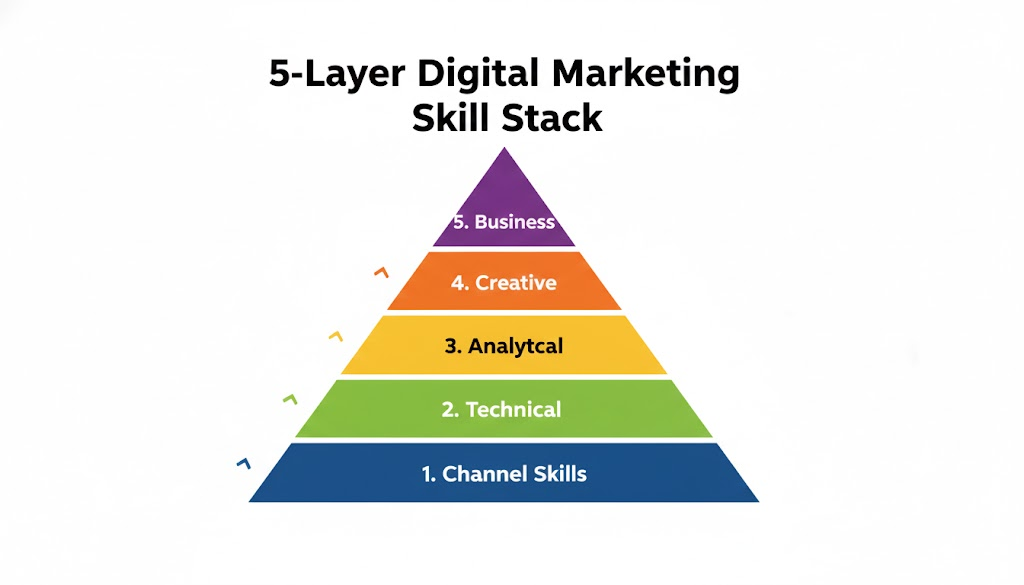
FRAMEWORK 3: The 5-Layer Skill Stack
Layer 1: Channel Skills
SEO, ads, email, social media
Layer 2: Technical
Analytics, pixels, tracking, website
Layer 3: Analytical
Understanding numbers and user behavior
Layer 4: Creative
Copywriting, design, storytelling
Layer 5: Business
Funnels, pricing, customer lifecycle
This framework determines the long-term growth of every digital marketer.
How to Learn Digital Marketing for Free (Detailed Blueprint)
If you want to learn without spending money, follow this free curriculum.
| Category | Items | Purpose / What You Learn |
| Free Courses (Best for Beginners) | Google Digital Garage Meta Blueprint HubSpot Academy SEMrush Academy | Fundamentals of digital marketing Social media ads and Meta ecosystem Inbound marketing, automation basics SEO essentials, keyword research |
| Free Tools (Practice-Focused) | Google Search Console (GSC) Google Analytics 4 (GA4) Mailchimp Canva ChatGPT Ubersuggest | Search optimization, indexing, queries Traffic analysis, events, conversions Email sequences and automation Social media and ad creatives Research, content creation, ideation Keyword research and SEO audits |
| Free Practice Projects | Build a niche blog Run a dummy ad Create a 30-day content calendar Do a competitor SEO audit Create an email sequence | Practice SEO + content writing Learn ads dashboard and targeting Develop content strategy Understand gaps and opportunities Practice automation and funnels |
| Free Blogs for Learning | AADME Blog Neil Patel Backlinko HubSpot Blog | Beginner to advanced digital marketing topics SEO, content marketing, keyword research SEO strategy, link building Inbound marketing, email, automation |
| Explore More | Digital Marketing for Students | https://aadme.co/blog/digital-marketing-for-students/ |
Career Paths After 30 Days (Fully Explained)
Once you finish the blueprint, you are eligible for:
| Career Role | Skills Needed / Services Offered | Additional Notes / Internal Link |
| SEO Intern / Junior SEO | Keyword research, On-page SEO, Basic technical SEO, Blog optimization, Google Search Console, Google Analytics 4 | Great starting role for beginners practicing SEO fundamentals |
| Social Media Executive | Content calendar creation, Reel editing, Hashtag strategy, Community management, Basic Meta Ads | Ideal for creative learners and brand-focused marketers |
| Performance Marketing Trainee | Google Ads, Meta Ads, Keyword match types, Audience creation, Retargeting campaigns | Salary insights: Performance Marketing Salary in India https://aadme.co/blog/performance-marketing-salary-in-india/ |
| Content Writer / Copywriter | SEO writing, Copywriting frameworks, Blog formatting, Persuasive call-to-actions | Recommended for strong writers and storytelling-focused learners |
| Marketing Automation Assistant | Mailchimp setup, Automation workflows, Segmentation, CRM usage, Lead scoring | High-demand role due to rise of AI and automation |
| Freelancer / Side Hustler | SEO audits, Instagram management, Ad management, Landing page building, Email setup | Flexible role ideal for earning from home or part-time |
Future Trends 2026 to 2030 (In-Depth Analysis)
Digital marketing will change dramatically by 2030.
Here are the most important trends.
| Trend | What It Includes | Impact / Key Requirements |
| 1. Search Shifts to AI Overviews and LLM Results | Google AI Overviews, ChatGPT Search, Perplexity, Gemini Browsing | Content must be structured, clean, factual, expert-written, schema-friendly |
| 2. AI-First Marketing Teams | AI Tools Handle: Copy, Creative, Analytics, Targeting, Optimization | Marketers Handle: Strategy, Messaging, Creative direction, Brand experience |
| 3. Personalization Without Tracking | First-party data, CRM, Zero-party data, Email journeys, User-tagged preferences | Email marketing becomes significantly more valuable because personalisation no longer depends on third-party tracking |
| 4. Micro-Influencers and UGC Domination | User-generated content, nano and micro creators | Brands prioritize authenticity over follower count, leading to higher UGC and micro-creator demand |
| 5. Rise of Full-Funnel Marketers | SEO, Ads, Content, Analytics, Automation | Hybrid marketers earn 10–20 LPA early in their career due to multi-skill demand |
Conclusion
Learning digital marketing in 30 days is achievable when you follow a structured, skill-focused system. I have worked with 50,000+ students and 5,000+ businesses, and the most successful learners share five traits:
They follow one roadmap
They practice daily
They build small projects
They learn tools hands-on
They leverage AI early
This 30-day blueprint is built on:
Search engines’ latest ranking behaviors
AI Overview-ready formatting
Industry hiring standards
Agency workflows
Real business case studies
If you are serious about building a high-income digital marketing career, start today.
Your portfolio is more valuable than certificates.
Your practical skills matter more than theory.
Your consistency will decide your growth.
You now have the most in-depth, AI-ready, beginner-to-advanced digital marketing guide– built to help you stand out in 2026 and beyond.
FAQs
What is digital marketing and how does it work?
Digital marketing is the use of online channels to attract, engage, and convert customers.
It works through a process where users discover your content, interact with your brand, and take action.
How it works:
- A user searches, scrolls, or clicks online.
- Your content (website, ad, email, social post) appears.
- They visit your website or landing page.
- They sign up, buy, or contact you.
- You follow up using automation or retargeting.
Can I learn digital marketing in 30 days?
Yes. You can learn the fundamentals of digital marketing in 30 days with a structured roadmap, daily practice, essential tools, and small real-world projects. Mastery takes longer, but 30 days is enough to become job-ready for internships and junior roles.
What should I learn first in digital marketing?
Start with:
- Marketing basics: funnels, audience, positioning
- Website setup: domain, hosting, CMS
- Content basics: copywriting, hooks, storytelling
- SEO fundamentals
- Analytics (GA4 + GSC)
This structure creates a strong foundation for long-term growth.
Is digital marketing easy for beginners?
Digital marketing is easy to start but takes consistent practice to master. Anyone can begin without technical skills. Your progress depends on how many projects you implement.
Do I need coding to learn digital marketing?
No. You do not need coding skills to learn or work in digital marketing. Tools like WordPress, Canva, Mailchimp, Google Ads, and Meta Ads are no-code. However, basic HTML helps with SEO and landing pages.
How long does it take to get a digital marketing job?
If you follow the 30-day learning path and build a small portfolio, you can apply for:
- SEO internship
- Social media internship
- PPC trainee
- Marketing assistant
- Freelancer roles
What is the salary of a digital marketer in India?
Beginners typically earn:
- ₹15,000 – ₹25,000 as interns
- ₹25,000 – ₹40,000 as freshers
- ₹50,000 – ₹1,00,000 with 1–2 years experience
- ₹1–3 lakh per month in performance marketing roles
What are the top skills required for digital marketing?
- SEO
- Content creation
- Copywriting
- Analytics
- Social media
- Paid advertising
- Marketing automation
- Funnel building
- AI tools
Can I learn digital marketing for free?
Yes. You can start with:
- Google Digital Garage
- HubSpot Academy
- Meta Blueprint
- Free tools like GA4, GSC, Canva, Ubersuggest
- YouTube channel playlists
- Free blogs
How do I start digital marketing with no experience?
Follow these steps:
- Learn basics
- Build a simple website
- Write 3–5 SEO blogs
- Create a content calendar
- Run a small Instagram ad
- Build an email sequence
- Track everything on GA4
- Publish your portfolio
Which is better: SEO or digital marketing?
Digital marketing is the umbrella. SEO is one part of digital marketing. Both are important. SEO helps with free traffic, while digital marketing covers ads, email, content, and analytics.
Can AI tools help me learn digital marketing faster?
Yes. AI accelerates work like:
- Keyword clustering
- Ad copy
- Blog outlines
- Analytics interpretation
- Content ideation
What tools should I use to practice digital marketing as a beginner?
Start with:
- Canva
- WordPress
- Mailchimp
- Google Ads
- Meta Ads Manager
- Google Analytics 4
- Google Search Console
- Ubersuggest
- ChatGPT
How do I practice digital marketing with no clients?
Use these project ideas:
- Build your own website
- Work on a dummy e-commerce store
- Create Instagram content for a fictional brand
- Make a landing page and lead magnet
- Run a ₹200 test ad
- Write SEO blog clusters
You can use these to build a portfolio.
What is the best roadmap to learn digital marketing step by step?
- Week 1 — Fundamentals
- Week 2 — Content + SEO
- Week 3 — Social + Email
- Week 4 — Ads + Analytics + Automation
This 30-day structure is scientifically designed to maximize retention.